Wednesday, July 23, 2025

IN MEMORY OF BUSTER

BUSTER: 
BORN APRIL 17, 2018
DIED JULY 4, 2025

We regret to pass along that our precious cat Buster has died.  He was 7 years old and with us from the beginning, even coming to live  with us in Ecuador.  We hoped and assumed he’d be with us for another 7 years, but it was not to be. The Vet diagnosed him with Feline Leukemia, and I’ll leave off describing most of his last days, except to say he did not suffer much.  


On April 17, 2018 his mother waddled up on our front porch.  She was hippo fat and ready to deliver, so she followed Rosie back down the walkway, out into the greenhouse where a cardboard box was set up for her birthing room.  In about an hour she had 3 black kittens, a gray one plus one long-haired black and white one, which was Buster.  In a few weeks homes were found for 2 of them, a brother and sister of Buster’s.   At one point some friends took Buster home, but it ended up one of them was allergic to his long hair.  And when he peed on the bed, Rosie brought him back.   Since I was already attached to him, I thought highly of the  mischievous act saying, “Way to go, Buster!”  


BUSTER AS A TEENAGER


So we ended up keeping Buster, his 2 brothers and mother, getting them all fixed after a while.  His long hair was soft and silky for a cat, as if it were shampooed.  People who petted him often remarked at how soft it was.  Each April or so we’d need to trim off his winter coat.  He allowed us to do this with very little fuss, and usually when it came to other jobs which most cats resent, he was uncharacteristically compliant. 


He was just different than his brothers.  When the kittens were just a few weeks old the mother moved them all to Rosie’s dad’s garage, just up the driveway.  We went looking for them, and found all of them except Buster.  Then we noticed a movement above us.  There he was walking on a board which protruded out from the loft as if he was in no danger.  He acted as if he were a mere 3 inches above the floor rather than the 3 meters which it was.  How he got up there we do not know. 


On rainy nights when we’d let all the cats inside. The others would make a dash to their food bowls.  But not Buster.  He’d be the last one in, and preferred to be petted and have his head scratched before meandering over to his food bowl as if eating were no big deal.  As you can see from the pictures, he preferred sleeping on his back, unusual for a cat.  We’ve often wondered if he did that because maybe his long belly hair made it too warm to lay in a more prone position.  Since that was a preferred resting position, I buried him that way. 


Before leaving for Ecuador we found homes for his mother and brother, the other brother having disappeared a year previously.  Between airplanes, airports and a long taxi drive, it was a 3 day venture and, while it was taxing, Buster endured it very well.  The question has been posed regarding cats as to whether they are more attached to owners, or to the territory they live in.  Buster was an indoor/outdoor cat, so we were not sure.  But we’d find out right away when he stayed close to us.  The first few times we let him out the cabin door and he went into the thick brush nearby, we feared we would never see him again.  But he’d reappear in 5-10 minutes.  He was smart.


We stayed in the cabin of a friend for the first 3 months in Ecuador, in which time Buster seemed fascinated with his new surroundings, but never going too far away.  We moved into our present house on July 4, 2024, Independence Day.  It would later be exactly one year to the day when he passed away.  In reminiscing about his last year we have concluded that little by little he became less active, becoming more of a house cat than previously.  We simply did not know his liver and other internal organs were fading little by little, hence less activity. Less exercise and being overweight did not help matters. When he was in a probable cat fight 3 weeks prior, he received a bite, and the wound became infected, going systemic.  So we took him to the vet where he stayed for 2 nights.  They revived him with IV fluids/electrolytes, antipyretics and antibiotics, and explained the diagnoses.   Because all communication was done via google translate, I assumed it was a mistake when they wrote something like, “With proper diet and medication his illness can be maintained and he can live a little longer.”  This inference was repeated the next day.  I was probably confusing his present infection with the leukemia he already had, and was never sure if the Vet was combining them when she explained diagnoses issues.  But since he had perked up nicely and was almost his usual self for 9-10 days, we thought he was in the clear.  But his appetite did not fully return, and little by little he retrograded, so we knew his time was at hand.  His immune system was just too compromised, and he would only live another 4 days. 


He had become a real Mama’s boy in his last year, often accompanying Rosie on walks, or being close by when she worked in the garden.  He often slept with us, sharing her pillow for a while before moving to the foot of the bed.  So it was only fitting that he should die in her arms.


It was 08:00 Friday morning, July 4 when he passed. Heart wrenching to say the least.  We cried as we looked at him, no longer breathing.  I told Rosie  that we should keep his red collar. He had worn that thing for 6+ years.  By now it was ratty and tattered, being held together with twisties, but I am sure he did not care.  We just wanted this as a little keepsake.  But it was not on him.


Rosie could not remember if she took it off him or not, but later looked in all the places where she was likely to have placed it.  Still not found.  We then assumed he had pulled it off recently, so it was probably somewhere on our property.  If it was not near any of his favorite siesta spots, it would be pretty hopeless to find such a small thing in the tall grass or brush where he’d occasionally go.  So we figured it was gone. I had looked here and there on the property, coming up empty.  But we still prayed it would turn up.


The next morning while having breakfast on the porch the idea came to my mind: “I wonder if the vet took it off?”  (And if they did why did they not let us know?)  It seemed like a long shot, but Rosie texted the vet while we were eating, who returned the text immediately saying they DID have it.  Wow!  Amazing.  Thank you Jesus.


We were planning a jaunt that day an hour to the south for a diversion, so stopped by the Vet’s on the way, and got it.  Phew!  This was a true Godsend.  Closure will be a little easier now, we hope.  


Some adjectives to describe him:  BIG.   He weighed 14 lbs at the Vets in Salem, Oregon, but less than 10 when he passed.  Bright eyed and bushy tailed.  Mischievous.  A Predator  to birds and rodents.  A companion - he liked our company.   Fun Loving - at 7 years old he was still playful.  Beautiful. Fun.  Smart.


We will miss him.  He was a special cat, and part of us died with him.  Enjoy the pics: 


One bright spot on Friday, July 4, the day we lost Buster, you may find interesting:


After Buster returned home from the Vet, we resumed our walks with him and the dog.  As he was still weak, we’d walk him to the lower part of our property with us and  sit on the hillside.  As he was weak we’d carry him back.  Here is a picture taken on 6/20/25, the day he returned home from the vet.  I am not sure why I took this picture, but it figures large in what follows.  We’d sit here almost daily.  


When his time was at hand, I dug a hole below that hillside, close to the fence line border of our property.  After we buried him, we sat on that same hillside, talked a bit, but I cannot recall any of the conversation.   Later in the morning, needing any sort of diversion, I walked back to the gravesite, and then back up to the same hillside just mentioned.  I closed my eyes and laid on my back, thanked God for the 7 years we had with Buster, but cannot remember anything else I said at the time.  


When I got up I noticed something white on the ground,  not 5 feet to my right.  It was just soooo white.  Why did I not notice this when I came here a few minutes ago, or when Rosie and I sat here earlier?  Or for that matter, was it there for the previous past 2 weeks when we had sat there?  We sat in the same spot every time.  I stood over it, still unsure what it was until I picked it up.  It was a bandage used for Buster’s IV site.  He hated them, and always tried to tear them off.  This bandage was with a cotton ball, something he returned from the Vet with 2 weeks prior.  We know this because we never used cotton balls after he came back.


He must have succeeded taking this one off, although where it was for the previous 14 days will ever be a mystery.  We sat on that hillside every day, and never saw it.  And when I noticed it, it seemed to be calling out “Look at me!”  The bandage was right where Buster was sitting in the pic.  Coincidence?  Not a chance.  


Well, sometimes  Providence has a way letting you know Someone watches out for you in your dark times.   How the bandage got to that very spot I do not know, but do know for certain it was NOT there during the past 2 weeks.  It would have been impossible not to notice.  I could speculate, but really don’t need to.  It would appear that Mr Providence is always a step ahead of us.  Some day I’ll understand the true significance of this, but for now I’ll keep trusting, and I think I’ll keep the bandage.



Tuesday, May 20, 2025

May Birding Trip - Part Two

May 7:  We left after breakfast to Catamayo, taking the loooong way to Loja since the direct route had an ongoing landslide clean-up area and was now closed most of the time.  We stopped near the main N/S highway where we added White-browed Gnatcatcher and a heard only Tumbes Sparrow.  We went through Catamayo and up the hill toward the pass, stopping at a side road where we added an Ecuadorian Piculet.  We then had a planned stop in S Loja at the Parque Colinar where we saw the Brazilian Teal, Common Gallinule and Plumbeous Rails.   The teal are in the midst of a range expansion, and my long distance blurry photo reveals 6 babies, so this is the 2nd brood this year. Probably the rarest out of place type bird of the trip.

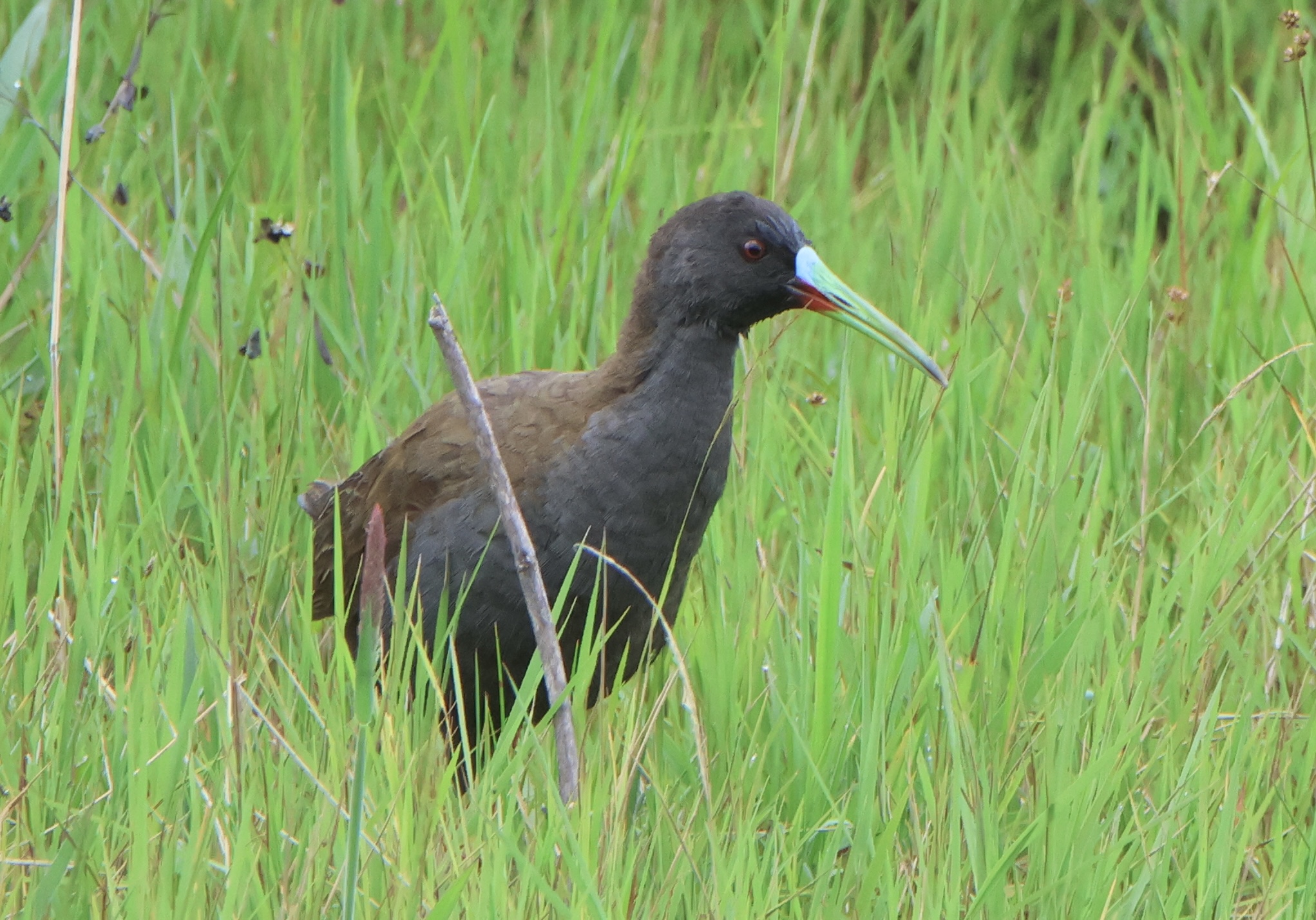
Plumbeous Rail

After some empanadas at the park we headed east over the pass and down the scenic highway toward Zamora.  We had researched a place where oilbirds were being reported and stopped there.  We looked and looked  but could not find them.  We did find a pair of White-capped Dippers, a little consolation.  Oh yes, we did see a Wing-banded Nightjar in the middle of the road in the middle of the day, an interesting surprise. 

Bran-colored FLycatcher

We drove the rest of the way to Zamora and over to the Copalinga Lodge.  As we were approaching the lodge, my car stalled.  I have to inject here that way back in August and September it was doing this, and I had a new fuel filter placed as well as dropping the gas tank for a cleaning, as well as other work, and it had been fine…… until now.  We got there in time for the Gray Tinamou feeding, but the guide Walter said the bird was not coming of late.  We tried anyway.  There were plenty of hummers coming to the feeders and flowers and we ended up tallying 9 species there.  Otherwise, both Russet Backed and Crested Oropendulas, Red-crested Finch, Silver-beaked and Green and Yellow Tanagers, Buff-throated Saltators, Speckled Chachalacas and others kept our interest alive. 


During dinner one of the local Band-bellied Owls piped up, and a little later Walter  asked us if we’d like to look for the Ocellated Poorwill which was calling, to which we did.  We walked along a “trail” of sorts, and after shining the flashlight a few places, he located it perched.  We could only see it from the back, but that is probably more than most would enjoy.  


We had our separate cabins and after an early breakfast were off with Walter to the nearby community of Timbara.   I had been here before in February with Aaron, Tim and Charlie and we had a satisfying morning of birding, adding >70 species to the accumulating list of birds.   So my hopes were up, and Walter did not let us down, hearing and pointing out numerous birds.  We had good looks at most of them, and some of the more interesting ones were:  Black Solitary Cacique, White Hawk, Short-tailed Swift, a male Spangled Coquette, Fasciated Tiger Heron, Anhinga, Lafresnaye’s Piculet, Stripe-chested Antwren, Masked and Black-crowned Tityra, Chestnut-crowned Becard, Long-tailed Tyrants, Violaceous Jays, Thrush-like Wren, Magpie Tanagers, Bluish-gray Saltator and a Chestnut-bellied Seedfinch.  We also tallied over 70 species.  By 11:00 the cloud cover had lifted and it was getting hot, and we were ready to call it a morning, so back to Copalinga we went.   When going to the morning location and returning, the car stalled 2-3 more times, but when I down shifted it restarted.  I was getting concerned. 


Ruddy-ground Dove

Smooth-billed Ani

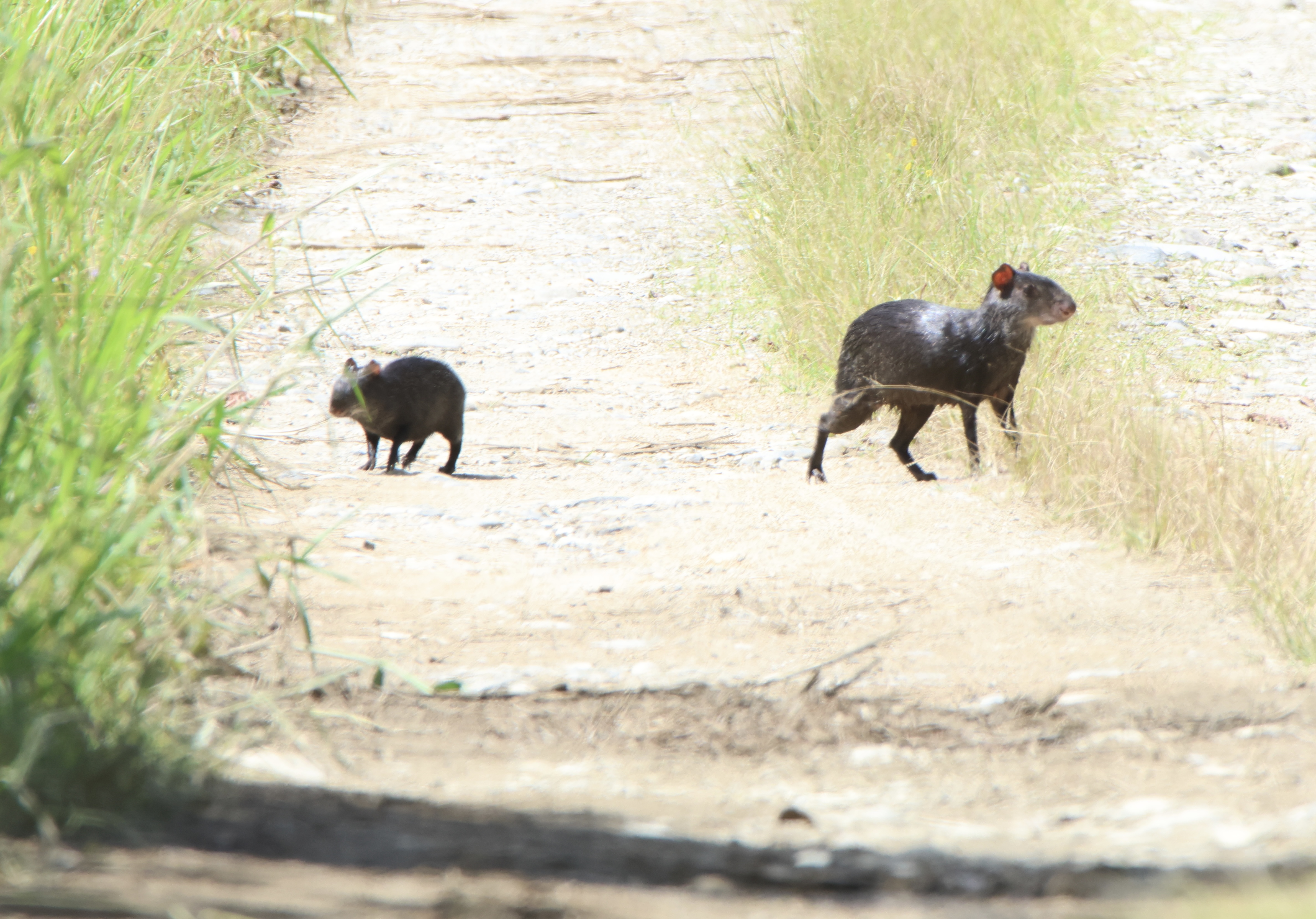
Black Agoutis - Mother and young

Yellow-tufted Woodpecker

Chestnut-bellied Seedeater

Palm Tanager

We did not resume birding with Walter until 3:00 when we walked some trails.  We would then learn the hard way that May is not the best time of year for birding here, and while we did not see much, we at least heard a few more.  Probably the best bird was a White-crowned Tapaculo.  

Wire-crestedThorntail

Green-and-gold Tanager

Thick-billed Euphonia 

Red-crested Finch

Thick-billed Euphonias

Golden-tailed Sapphire


Shortly after dinner Walter came into the dining room asking us if we’d like to try to see the Band-bellied Owl, to which we said yes.  On the way out, when I reached the gravel just beyond the threshold, I spied what I thought was a small snake.  Sure enough, it was.  So I made sure Barb and Eric did not walk over it.  It turned out to be a young Fer-de-Lance, a highly poisonous viper of the tropics.  Walter decided to put it in a pop bottle which he later released down by the river.  Hmmm, a little excitement for the trip.  After a few tries we did get a visual on the owl.  


The next day we’d head to Podocarpus NP with Christian, our guide for the next 3 days, who arrived at 6:30 and we were soon off.  We’d also learn again that May is just not the best birding time here, and the day was a bit of a let down with only 34 species recorded, which did not include the Cock-of-the-Rock or Umbrella Bird, the two we were really hoping for.  But we did see a Green-fronted Lancebill, White-necked Parakeets, Montane and Lineated Foliage Gleaners, Black-billed Treehunter, White-crowned Manakin, Orange-eared and Golden Tanagers, and Black-faced Dacnis.


Squirrel Cuckkoo

Violaceous Jay


After lunch at Copalinga we were off to Yantzaza, Christian’s home town where we planned to stay for one night, and maybe more depending on how things went.  But my car kept stalling now and then, and after a short birding jaunt near town, I dropped Eric and Barb off at the motel, and went with Christian to a mechanic he knew.  I asked him if he could replace the gas filter and put in a gas additive, which he did.  I really wanted to see the inside of the old filter, but the mechanic held up the old one and drained some fluid out, saying it was water.  I was not convinced.   The car stalled twice en route to the motel, and I was not feeling optimistic about the following day.


But the next day started out just fine and the car functioned properly…… for some 90 minutes.  We headed up into the Zarza Reserve, stopping here and there for birds. And then the car began stalling.  And little by little it kept stalling more and more.  After some great birding we turned around, fearing we’d not make it back.  We made it partially back, barely limping into the tiny village of Zarza where Christian had a friend.  He called a tow truck which arrived in about an hour.  While waiting Eric and Barb had a beer with some local store owners.

Improvising for an umbrella

A Snapshot of the Zarza Reserve

A Large Worm

You can see Christian in my car


Christian and Eric rode in the car on the back of the flatbed while Barb and I rode in the cab.   I swear that driver came off the mountain faster than I would have in my car.  Once back in town we went from one mechanic shop to another, all closed.  Finally we found one open.  It was late on Saturday, but the mechanic said he’d try to diagnose it in the morning, but he felt fairly confident it was the fuel pump.  


But before I relay how it all turned out, I must say that the Zarza Reserve did not let us down, and we tallied some 53 species.   Choosing the more interesting ones might be biased, but these were some:  Blackish Rail, Rufous-rumped Antwren, Olive-backed Woodcreeper, Equatorial Graymail, Spectacled Prickletail, Cliff Flycatcher, Lemon-browed Flycatcher, Bar-winged Woodwren, Chestnut-bellied Thrush, Blue-winged Mountain Tanager, Deep-blue Flowerpiercer, and 9 species of tanagers.  So while the car was not functioning well, and the rain started to come down, we had a good birding experience.


Blue-necked Tanager

Short-crested Flycatcher

Tropical Kingbird

Donocobius

Blue-black Grassquit

Yellow-rumped Cacique

Laughing Falcon - a long shot - fuzzy


Sunday morning Christian took Eric and Barb for a 3 hour birding jaunt nearby.  Not knowing how the car situation would turn out, they wanted to be back by noon so as to take a taxi home, but since the rains were heavy of late, the local river had overflowed its banks and traffic was not going through to Zamora.  Hmmm.  We were really doing some brainstorming, exploring the options.  Another idea that crossed our minds was to hire the flatbed truck driver, put the car on it again, and drive through the high water.  Plus, my wife had relayed something about a landslide between Zamora and Loja.   What else could go wrong?


The mechanic had relayed that the fuel pump was working, but he really needed a vacuum type of gauge to figure out if it was sufficient, which he could not do until Monday, the next day.   So the options we talked about were going to Cuenca via taxi/bus, staying there overnight.  Either flying from there back to Quito or taking a taxi/bus to Catamayo where they would need to be by departure time late Wednesday, or…..maybe the car would be fixed, and/or the river would subside enough.  


Monday morning arrived and by mid morning the mechanic had used the vacuum gauge and determined the fuel pump was not supplying enough gas to the motor, so he began putting in a new one.  So we at least thought we could take the car to Cuenca if need be.  By noon the mechanic had the new fuel pump in, and we were there while he was checking it out.   But the vacuum gauge still indicated the same problem - not enough gas.  So he was soon on the phone trouble shooting with someone who suggested that the next thing to check was the wiring to the pump.  Knowing that would take a while, we left.   By mid afternoon the mechanic said the car was ready, so Eric and I went to get it.  The mechanic said the bill was $100, but we gave him $20 extra.   He probably worked on it for 5 hours.  So we drove it around a bit and it did OK.


But now the same dilemma needed addressed.  We were assuming we’d have to head north to Cuenca, a 4+ hour drive NW, so began talking about looking for eBird hotspots to check out along the way.  But around 8 PM Christian texted me saying his wife just drove through the high water area with no problems.  With no rain in the forecast, things were looking OK for the next day to drive back home.


So after breakfast, about 08:00, we loaded up the car and I turned the key.  Usually it starts in one second, but after 5 seconds of cranking and no start, my heart sunk.  I was dreading more set backs.  But the 2nd time around it started right up.   Phew!  


So off we went.  The area of the flooding was completely dry.  Ka-ching!  We stopped at the Malecon in Zamora, but the birding was dead, so we kept going.  We passed the said landslide area where there was only a bit of mud.  But not long after that we came upon a line of vehicles which we parked in back of.  I asked someone about the problem to which he said it was a landslide, and he thought it would take an hour to clean up.  Five minutes later a large earth hauling machine passed us by and went right to work.  It took about 90 minutes for traffic to resume.  We ended up going back to the oilbird spot, but did not have success with that.  We did see a torrent duck in the raging river.


The rest of the trip to my house was uneventful, taking another 3 hours because we still had to drive over to Catamayo since the road to Malacatos was not open yet.  My car is 20 years old, a 2004 4WD Vitara.  We are fairly determined now to purchase another car, newer and more dependable. As there are a lot of Hyundai Tucsons on the road, we lean that way.


Both Eric and Barb were troopers, taking the last few days in stride.  There were lots of temporary unknowns to become worried about which made some things inconvenient.  But everything worked out in the end.  I opted to have them take a taxi to the airport.  I was tired and did not want to expend the energy for a 75 minute drive to the airport and back.  


We tallied over 300 species of birds, many lifers for Eric while most were for Barb.  By now I am getting much more familiar with the locations described as well as the birds, so if any of my readers want to come down for a birding jaunt, drop me a note.  


Also, in about a year from now we may be returning to Oregon for a “vacation” for which we’ll need a house/pet sitter.  So if that interests you, let me know.