Hi All,
We’ve been itching to get out and explore since we’ve been here, and circumstances finally allowed us to take a short jaunt from January 8-11. The main deciding factor is that our tenet from Austria is responsible, and we felt she could hold the fort down, feed our cat and dog, and water the plants. That is, before she goes to the coast for a month or two next week. The other factor was that our car is now working properly.
 |
| THERE ARE MILES OF YELLOW FLOWERED FOREST AT MANGHURCO |
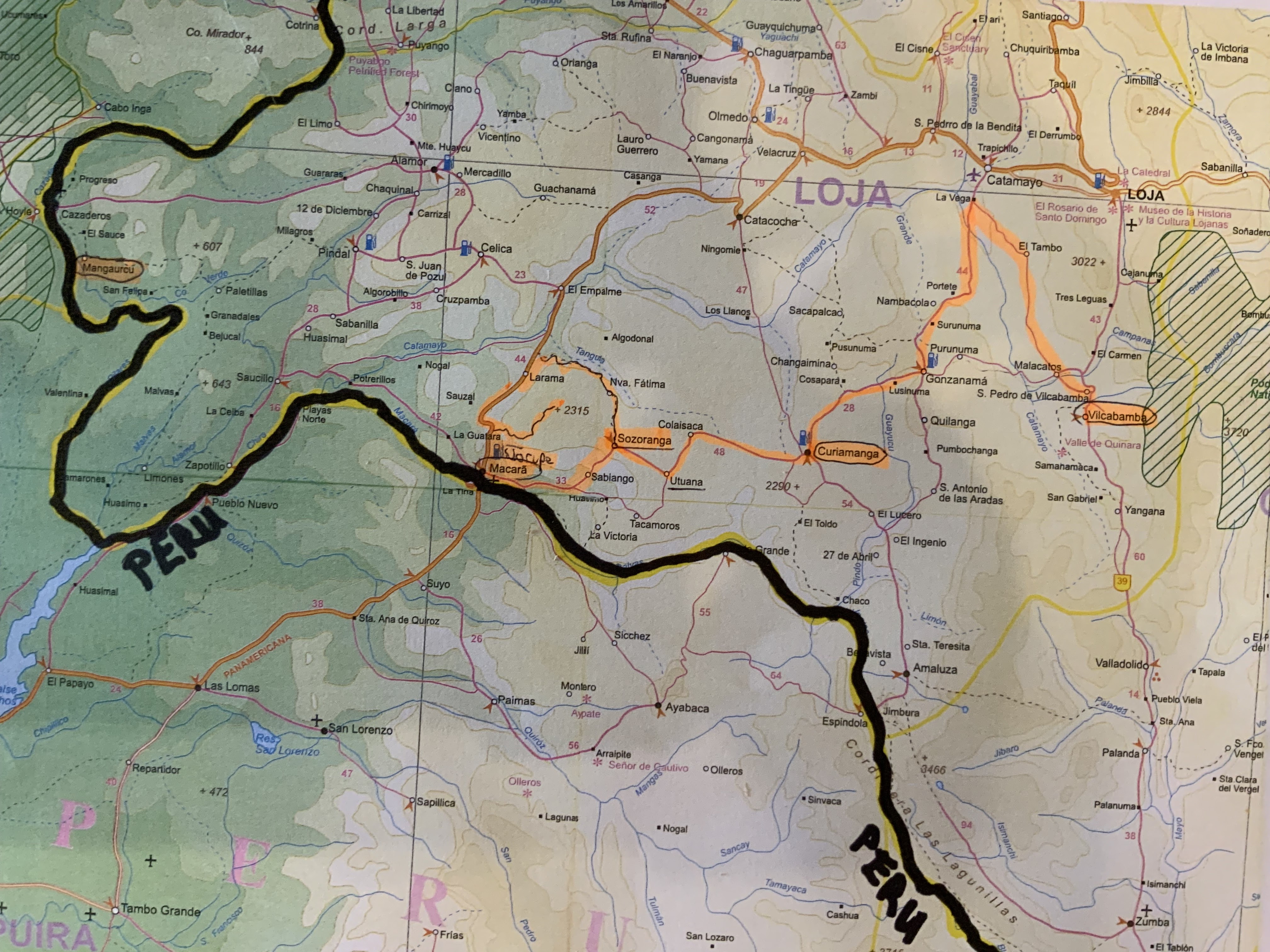 |
| THE MAP GIVES A GOOD IDEA OF WHERE WE WENT. BASICALLY EAST AND LOWER IN ELEVATION. |
I knew of some birding hot spots near Macara and Sozoranga, a four hour drive from our home. So I did my due diligence and figured out where we could stay near Macara, with intentions that when we left there, we could head back west
and then south to the very bottom of the country, weather permitting. (That last part did not materialize due to weather concerns).
We left mid morning, and after heading south from Catamayo, it was all new scenery. At times the vistas were almost breathtaking. While we would never leave sight of mountains, they were not as impressive as the main spine of the Andes. Lots of hills and valleys, the roads were rarely straight, with the occasional small hamlet or town. Driving through the small city of Cariamanga would have been puzzling if it were not for using the Google Map app.Most of this time so far we were gradually climbing in elevation. At the pass we reached the hamlet of Utuana, which local birders know for the cloud forest reserve, and I made a point to stop here. When we had left the sky was at least partially sunny, but now it was gray and overcast. We parked at the entrance road and began walking in. I find it intriguing how thick the vegetation in a cloud forest is, lots of moss on all the trees, and just how moist the area is. Unfortunately it began to rain after about 10 minutes and we got soaked! We had to leave quickly with only 3 species on our bird list, 2 of which were heard only.The last hour of driving to Macara was all downhill, but first we stopped in the town of Sozoronga, just a little farther along to eat lunch, and yes, by then, it had stopped raining. This town is literally perched on a hillside so most of the roads go up and down, some rather steeply. We found an area to park with a beautiful view. This town forms the western part of a triangle with some undisturbed land patronized by birders. Little did we know we’d be back the next day on another jaunt.As we descended we could sense the temperatures and humidity increasing. Eventually we reached the bottom where the terrain was flat and we paralleled a river the rest of the way to Macara, and the road was even straighter. Just before reaching the city the road climbed a bluff which overlooked the city, and Peru was just across another, larger river. We pulled over and took some photos.

Notice those yellow trees? They are the same as the ones where we would have gone, only there are miles and miles of them there.
We did not go into the city, but hung a right as our lodging was out of town a bit, which we found soon and checked in. After getting settled, the manager offered to drive us up the hill so we could bird our way down. We needed a walk anyway. It was late in the day but the birds were still quite active, so it took us a while to get back. When back I talked to the manager again, and I thought we had it arranged for him to take me much farther up the hill first thing in the morning.When morning arrived, the manager was no where around and neither was his car. His worker was going to accompany me up the hill…. walking. I decided to take my car, and his worker thought he had to “guide” me up the hill for some reason, which turned out to be a waste of his and my time. But most places where we stopped the birds were plentiful. I should explain that birders use the eBird system, and one can find “hotspots” where birding is best. That is how I knew this road was visited by others, so the lodging was quite convenient.I don’t remember what time I got back, but we had breakfast, and decided to take a drive where we could also hopefully go for a walk. We went back down to the main road and hung a right, and went up in elevation to another “hotspot” road that went off to the right in about 20 miles. It was actually quite level and we enjoyed a walk of over a mile one way, turned around and came back. I should explain that in many birding situations, birds simply do NOT like pygmy owls, especially during nesting season. So if you play a pygmy owl call a few times, you may get a response from various birds that come in to scold the owl. They came in to check out the owl as expected. I do this almost everywhere I bird now. On the present walk it worked like a charm, and many other birds came to check it out, including this Peruvian Pygmy Owl:

When back at the car we considered continuing farther on the same road since it was flat. I told Rosie that it came out at Sozoranga where we ate lunch the previous day. She was all in and so we took off. This dirt/gravel road was in good shape, and the scenery was great. Being quite level meant you would skirt around the various hillsides, and you’d never know what direction you were going. We’d see a road across a canyon and be over there some 10-15 minutes later. Once in a while we’d come into a small village. Here is some scenery along the way:

 |
| OVER THERE WAS THE TOWN WE THOUGHT WAS SOZORANGA |

We eventually spied a large town and figured it was Sozoranga, but when we got there learned it was not. The google map app was working then, and I determined we were only half way to Sozoranga. Phew! After that town the road was mostly 2 lane, and occasionally muddy from more usage. After another 45 minutes or so we made it to SOZORANGA, hung a right, and headed downhill once again toward Macara.This time we went into Macara for lunch. I expected it to be ramshackle and dirty, but to my surprise it was well kempt by Ecuadorian standards. We drove around some of the main streets a bit looking for a restaurant, and finally decided on one that had “Israel” as part of the name. We ate some kind of thing that was deep fried. The lady told us the name of it, but I cannot remember. I think it was chicken, cheese, and ? wrapped in dough and deep fried. I placed a napkin on it to absorb some of the oil. It was then that it sunk in why many Ecuadorians are getting overweight. They eat a lot of food which contributes to that.From there we drove toward the big river that divides Ecuador from Peru as I wanted to look over the rice fields to look for waterfowl. There was a flock of Black-necked Stilts, one each of Greater Yellowlegs and Spotted Sandpiper. Otherwise, plenty of Cattle Egrets and a few Great Egrets. Comb Ducks were also a plenty. Two raptors we saw were a Savannah Hawk and Crested Caracara. At the end of the road was a gazebo-like building with a large porch overlooking the river, which was very muddy from the rains in the highlands.
 |
| A SMALL PORTION OF THE RICE FIELDS |
 |
| THE GAZEBO PATIO WITH THE MUDDY RIVER |
We decided we had enough of that place, so I arranged to visit the Jorupe Reserve in the morning. To do so we drove back toward town but hung a left before getting there, went a few miles to the entrance and drove another mile to the lodge and cabins. The name of the lodge is the “Urraca” Lodge. We were greeted by the “Ranger,” paid the entrance fee, and were then free to roam around. The dirt road continued farther and we opted to walk on it. The birds were plentiful. The whole area was in a large valley that was undisturbed by agriculture except for a few small farms in the lowest parts near a small river.Now that the rainy season had reached the lowlands, all the trees had begun to leaf out, so the sights and smells were green and verdant, and bird song was continuous. One feature of the entire area were the large Cieba Trees. Pictures describe these better than words, so here are a few of them plus a couple of the general scenery there.

 |
| THE ROOF OF THE LODGE |

 |
| THIS ONE LOOKS LIKE ITCOULD BE THE FRONT LEG OF A BRONTOSUARUS |

Later that day a group of 4 from the University of Loja, not far from where we live, arrived to do some research on frogs. One of them told me that the Cieba trees had no good use and no one has yet to figure out any benefits they might be to the forest.
I think it was close to noon when we got back and talked with the local management about spending the night there. They called a lady named Paola who also spoke English. I had recently corresponded with her regarding future lodging elsewhere in the Jocotoco system, so she recognized who I was, gave me a discount and also applied the entrance fee we had paid to the lodging fee, so we were set to stay for the night.
It was nice to be in a place which was clean, organized, and set up mostly for birders with a bird guide in residence. Out back was a feeding station patronized by squirrels, chachalacas, jays and doves. A few other birds would come there when permitted by the bullying jays. There was also a blind for the photographers.We were shown to our cabin and got settled in and were asked when we preferred lunch, which ended up being about 1:30 After lunch we walked the road back in the direction we came in from. Even though it was in the heat of the day, the birds were still quite active, much to my satisfaction. During these birding forays my camera was getting much usage, and I’ve decided to make another link for only bird pics, or this blog would be way too long. I also wish I knew the bird songs here better, but that will just have to take time.
 |
| THE DINING AREA NICELY SCREENED IN, TO KEEP OUT THE BEETLES |
After getting back to the lodge area, I asked Leo (The Ranger) about owls, and he said there was a place to find the Buff-fronted Owl which we could go to, at 07:00. So after dinner Leo went with the researchers from Loja while we went with Luis, the maintainance man. We drove back to the highway and hung a left. After a mile we pulled over and walked into a field and played the appropriate song. In about a minute the hoped for owl responded, but after about 10 minutes of back and forth, he would not come in for a visual, so we left. In driving on the highway at night I met 3 cars coming toward me and one which came up in back of me. All of them had their high beams on and did not lower them. Some day I may write a blog about the poor driving habits of many in this country, which are dangerous and frustrating. But light that was not sooo bright was the reflection of eye shine from the huge moths that crossed in front of my headlights. I did not know such was possible.
When we went to our cabin after owling, the porch light was on. I felt some crunching under my feet as we walked up the steps. We quickly figured out the light had attracted a hundred or so small brown beetles, so we brushed these away from the door so as to keep them out.
 |
| MANY SMALL BROWN BEETLES |
Later that night, while in bed, I heard another Buff-fronted Owl, as well as a Peruvian Screech Owl and a Spectacled Owl, the later a nice addition to my Ecuador bird list.
At daybreak I got in the car and drove farther into the reserve, past where we walked the preceding morning, found a place to park and walked both to the river and along the road. The ambiance was gripping me with peace while the birding was also satisfying. But I could only be gone a couple hours as we needed to eat breakfast and be off. I wanted to be back at the Utuana Reserve where we had gotten rained out 3 days before.
After breakfast we bid our good-byes and were off, back on the highway, heading “up” toward the pass at Utuana. The sky was overcast and gray, actually a nice welcome from the heat, but after some 45 minutes I could see we’d probably be reaching and driving in the fog. Sure enough, we got into the thick of it, turned the lights on, and had to drive about half as fast as we normally would. At least there was very little traffic. At one point I almost ran over a dog sleeping in the road, something common here. Livestock owners are in the habit of tying their horses or cows alongside the road to graze, and these are often partially out in the road, so you have to be on the alert to avoid them. A few are also not even tied, which needs no further comment.At the Utuana Pass we kept going as it was raining now, and any hope of visiting the reserve would have to wait for a future time. We were now descending toward Cariamanga and little by little the fog was lifting. At Cariamanga we had to go through a military checkpoint. I showed the officer in uniform the registration and my driver’s license, and he waved us along. However, we got lost in the city and had to ask directions a few times, eventually getting back on the main road.As we wanted a walk before we got home, we found a satisfactory road along a river. So we drove in and parked. The sky was still overcast so we did not have to walk in the brutal equatorial sun. Afterward we drove the last hour to home.Little by little we are getting acquainted with the physical features of Ecuador, its people, and of course the birds. We won’t be going on any more jaunts until our tenet returns. The next one is likely to be a large loop to the south which goes up over a mountain range and into Zumba (see the map), a humid city in the lower SW portion of the country. However, before then, a couple friends from Oregon are coming in February for a birding trip, and a local birder/photographer friend will also be along. If in the future you’d like to consider birding here, shoot me a note with your questions.