CERRO DE ARCOS
In 2017 someone was exploring an area in the mountains of Southern Ecuador for tourism possibilities, way up in the windswept paramo. While trapsing an area at 12,000’ elevation, he spied a Hillstar type hummingbird. He knew they were not supposed to be there, and soon after brought others, and so the discovery of the “Blue-throated Hillstar” became new to science. They determined that not many of these birds were in existence and immediately afterward efforts were made to raise funds to buy property here. Some 600+ acres were purchased to protect the species’ habitat. After hearing this story and looking at pics of the bird, I knew I had to get there, so this is the story of my adventure.
At midday, November 16, Christian, my birding friend and I, left the town of Saraguro and headed west. The Google Map ap indicated it was a 3 hour jaunt. The first hour was on a nice concrete, typically windy road through mountainous terrain. The scenery was great! Hillsides were dotted with houses and the occasional small village. We were in the heart of the indigenous population, descendants of the Inca. Virtually everyone who lives here farms the land, and somehow eeks out their living.
The second hour was on a decent two lane gravel road. A little dusty at times and not many potholes. I wish I had a compass sitting on my dash as I never knew what direction we were going. I’d look a few miles across any given valley only to see a road I’d be on in 20 minutes, or one I’d be on in 20 minutes. I suspect at times we were headed east in our effort to end up in the west. There was always a river at the bottom of these valleys, and we’d stop at the bridges to look for a White-capped Dipper, but were not able to find one.
Here are some pics along the way:
 |
| A COMMON SIGHT ON ANY BACK ROAD IN ECUADOR |
 |
| I WAS ON THE ROAD ACROSS THIS VALLEY 20 MINUTES BEFORE |

At the end of the 2nd hour we reached the turn off for Cerro de Arcos. I’m thinking, “How much farther can this place be?” So I asked Christian if it was really another hour, to which he said “Yep!”
 |
| THE TURN OFF TO OUR DESTINATION |
The road was now one-lane, bumpy, windy, and uphill. It continued like this for half an hour before coming out into wide open spaces, fields with a few cows here and there, often with rocky hills edging the vast landscape. The climb was more gradual now, and the views stunning. The road was now back to two lanes with the occasional pothole. In the distance in most directions were rocky mountains. Unfortunately these views were partially obscured at times by smoke from the numerous fires which had been resulting from the present drought.
 |
| MORE COWS IN THE ROAD |
We finally reached the turn off for the lodge. Another 5 miles farther uphill. The road now deteriorated and I was glad for a high clearance vehicle. Winding around corners as we ascended a more steep climb, we finally came to the lodge entrance and in another 500 meters we reached the rustic building. We were now at 12,000 feet. The air was thin and cool. We were welcomed and shown to our lodging.
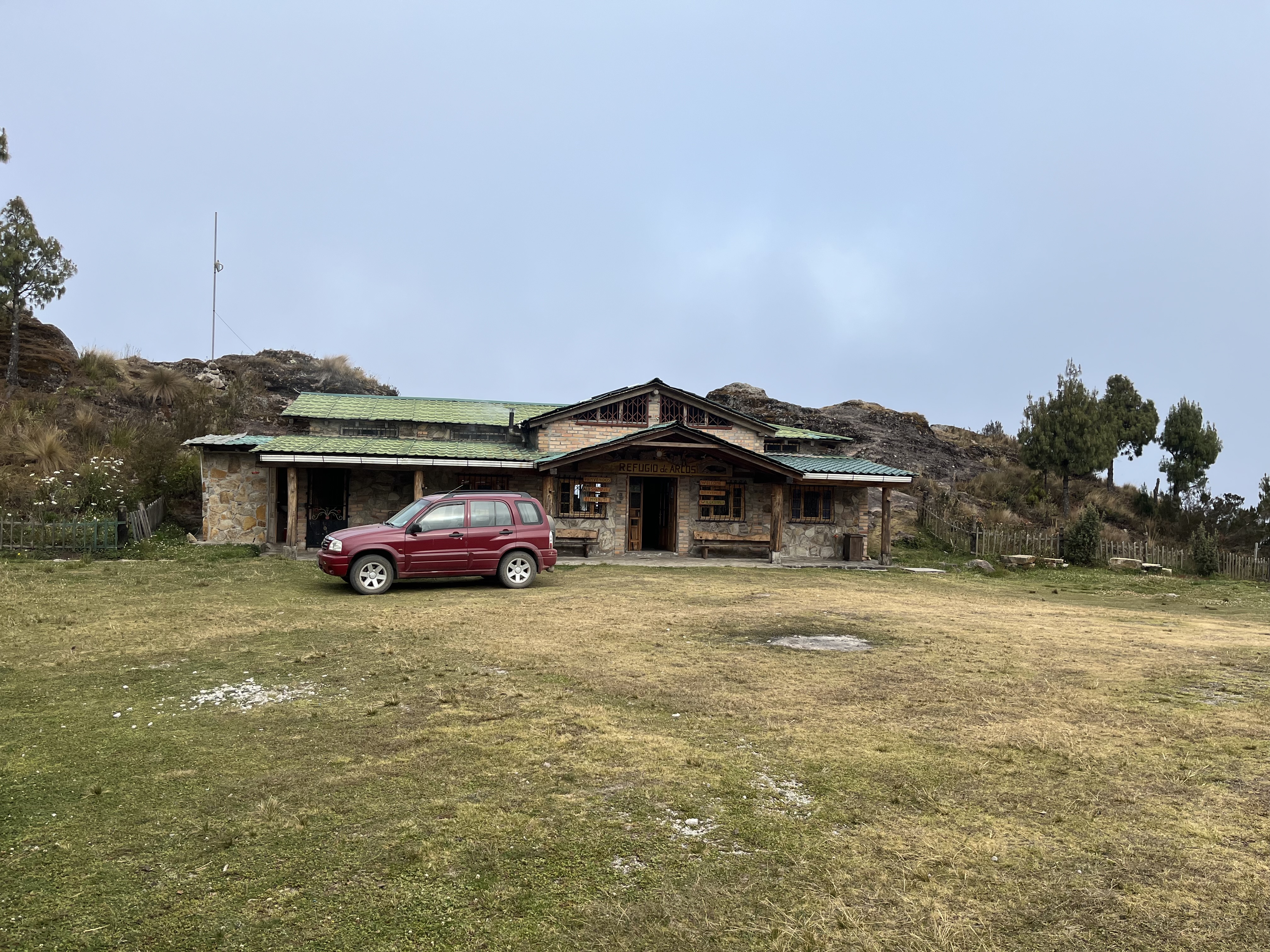 |
| THE MAIN LODGE WAS BUILT “ON THE ROCK.” |
 |
| THE ROCK GAP INSIDE THE BUILDING. LOOKING BACK TOWARD THE FRONT ENTRANCE. |
The main “lodge” was built in the gap of rock formation. I think this was done, at least partially, to block the wind from funneling into the main parking area. The lodging where clients stay was built perpendicular to the lodge, and I think there were 7 rooms, all with wood stoves. My wood stove was going and my room was toasty. The bed was pleasantly soft! Most of the time the beds at any lodging in Ecuador are very firm (Tierra Firma).
 |
| THIS PIC WAS TAKEN FROM THE TOP OF THE ROCK ON WHICH THE LODGE WAS BUILT. THE CONNECTED CABINS OFF TO THE SIDE. |
 |
| YOU CAN SEE THE ROAD WE CAME UP ON IN THIS PIC, ALSO TAKEN FROM THE TOP OF THE SAME ROCK. |
After being greeted and having placed our belongings in our rooms, we were off birding. The Hillstar feeds exclusively on the flowers of the Chuquiragua Plant. We were informed where 3 groupings of the plant were located. Back to the car and up the hill 1 km, and we parked at the trail entrance. While in reasonable shape for a 70 year old, it was a grind walking up farther. At 12,000 the oxygen depleted air can slow a person down. Luckily the climb was only about 200 meters and then it basically leveled off. We passed a small pond which had an Andean Teal in it, a nice addition to my Loja Province bird list.
 |
| ANDEAN TEAL |
We finally reached the location to look for the Hillstar. I was perplexed in that what was considered to be a “protected” area, was obviously used by cows and horses. (They must not eat the same plant that the Hillstar likes, or there would not be any). Plus, there was another road which reached the area by young studs with motorcycles, who freely came, and CAMPED here!

(The next morning we counted 12 people packing up to leave. Depressing to say the least.)
After scouting around a bit, we found a nice concentration of the plants and sat down to wait it out. In about an hour I saw one whiz by, a male. It was easy to ID him with his black center-line patch surrounded by gleaming white sides. Here is a picture of the picture that hangs in the lodge:
 |
| BLUE-THROATED HILLSTAR |
 |
| Chuquiragua Plant with orange flowers |
We made our way back to the lodge just in time for dinner. The lodge was also kept warm with wood stoves and the heat was welcome now that the temperature was cooling off. While some of the property in the area was purchased, I never learned who actually built the lodge. I did learn that there was a joint effort of Italian and Ecuadorian missionaries to run it, and the proceeds go to help the local communities. Sometimes one has to get creative in their endeavor to make ecotourism work.
While the bed was comfortable, I still did not sleep well for some reason. Nevertheless, I was outside at 06:00 and there were a few birds around, most posing for my camera:
 |
| GREAT THRUSH |
 |
| SHINING SUNBEAM |
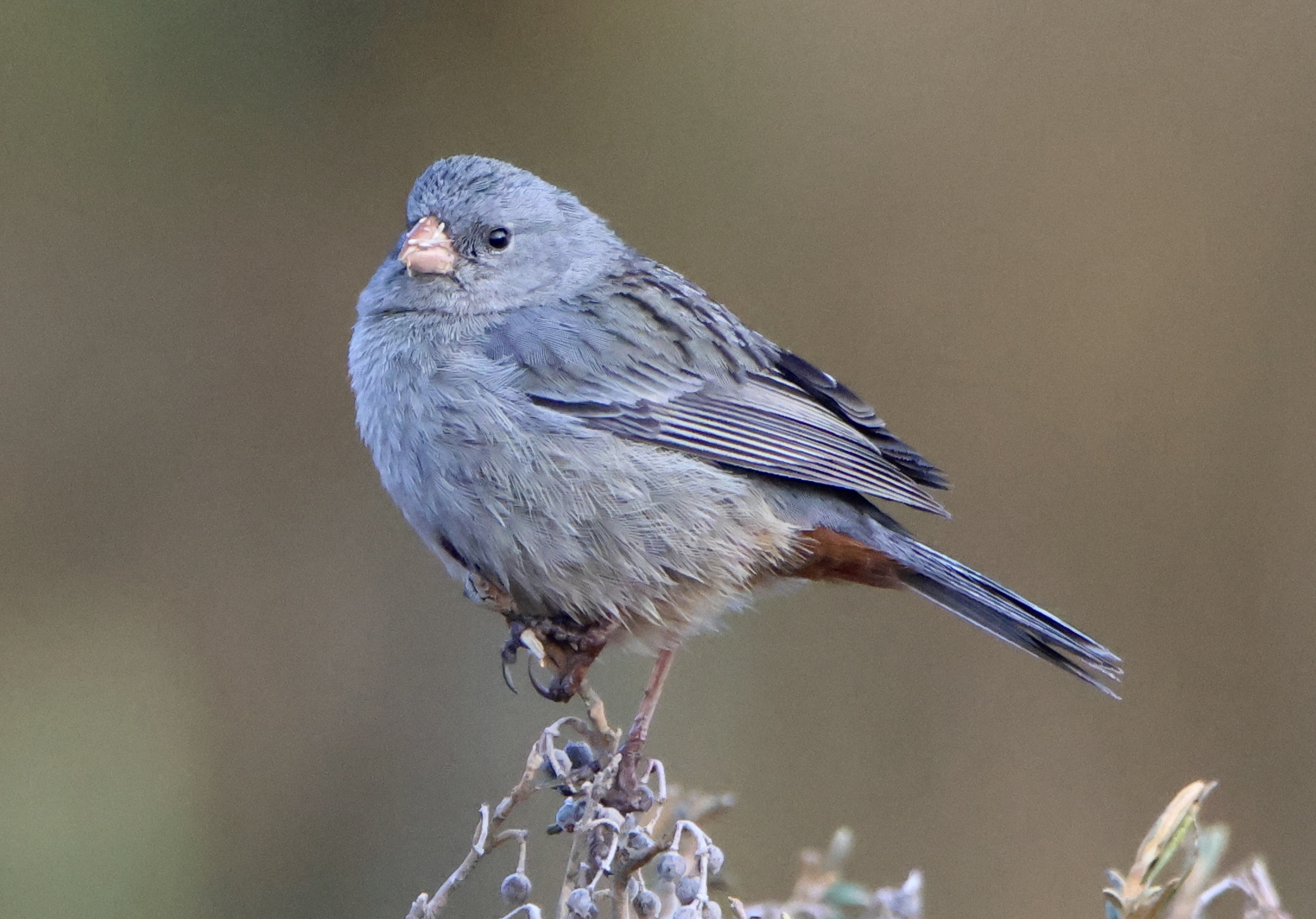 |
| PLAIN-COLORED SEEDEATER |
 |
| MANY-STRIPED CANISTERO |
 |
| PLAIN-CAPPED GROUND TYRANT |
 |
| BLACK-BILLED SHRIKE TYRANT |
After breakfast at 06:30 we were off to a patch of those bushes whose flowers the Hillstars like. We waited there for at least an hour without seeing one. We did learn that February-March was when the flowers were in full bloom when the hummers are more attracted to those areas. At least there was this female Black-tailed Trainbearer which came by, as did this Black Flowerpiercer and few other non-hummers
 |
| FEMALE BLACK-TAILED TRAINBEARER |
 |
| BLACK FLOWERPIERCER |
 |
| The patch of Chuquiragua Plants below us |
It was now back on that grueling trail “up” to the other patches. Once there we split up, with me going to the spot we were yesterday. In 5 minutes Christian showed up telling me to come to where he was as he saw 3 of them, so off we went. After hanging around the place a female finally showed up, and she did not even stay long enough for pics. This Great Sapphirewing did though.
 |
| GREAT SAPPHIREWING |
It was a little bit of a let down to have come all this way and not have a male Hillstar oblige us. But, that is how birding is sometimes. I may just return early next year with Rosie my wife with hopes of seeing one. I only hope she can handle the altitude.
We meandered back to the lodge. En route we saw this Mountain Caracara, a lifer for me.
 |
| MOUNTAIN CARACARA |
In our time here we only tallied 20 species, which seems low. But most were high elevational species, and the higher you go the less you normally see. There were hummer feeders here, hence the above photo of the Shining Sunbeam. Too bad they bully the other hummers who would come to them.
After lunch we drove the 3 hours back to Saraguro where I dropped Christian off, and continued 2 more hours home. My car was filled with dirt from the dusty roads and I’m sure the old rig has a few more notable rattles.
Cerro de Arcos, as translated, means: Hill of Arches. This is said to be from all the weird rock formations. Here are some scenes to behold:


