Hi All, As I start to write this, it is October 11. So we’ve been here for just over 6 months, 3 of those in our own home. We pretty much are on a routine with not too many surprises after the paperwork and other necessary things being out of the way. We are trying to fit in here and there, so it is nice that there are many expats in the area to lean on for advice.
I have to admit it has been difficult for me to just “go with the flow.” I have decided the reason has to do with my background. As an RN I needed to learn some time management skills, so my job was all about efficiency. Plus, in America we are used to a system that one can usually count on, although customer service is generally a thing of the past. Here…….things are different. “Manana” does not necessarily mean tomorrow. It can simply mean at a later time. We’ve had our frustrations as we try to get things addressed. But we intend to keep being positive as we believe the benefits outweigh the shortcomings. Efficiency is usually overdoing things here.
Our new (to us) house needed a little work. The first order of business was to address the roof. The former owner did let the realtor know that 3-4 times a year, when there is one of those torrential rains, the roof leaks. I think we have concluded that these rains are accompanied with high winds, which lift up the tiles so water can get under them. He did not relay how many leaks there were, or how bad they were, or where they were, but the groundskeeper said some were on the other side - the 2 bedroom side. The house is 10 years old, and the common clay tiles were discolored blackish with the mold/algae that is prevalent here. So I hired the groundskeeper from Angel’s place where we stayed in a cabin for 3 months, and I helped him pressure wash the entire roof, and repair or replace the tiles that needed to be worked on. I’ll be curious to know just how good of a job we did. (Due to the high winds of July-Sept, one of those tiles was now displaced, so I fixed it) . So far we’ve had some light rains and no leaks so far.

 |
| YOU CAN SEE THE BLACK DISCOLORATION |
 |
| THE FINISHED ROOF |
Providentially I became acquainted with a builder in the area who is from Canada. He spent his High School years in Quito and ended up marrying his Ecuadorian girlfriend. After school in Quito he returned to Canada and eventually started a geothermal business, which he sold and then retired at 32. He got bored here so began building, runs 2 crews and likes to stay busy. So after some chit-chat, I hired him to build a back patio/porch. The addition was to be added as an extension to a former addition, and seemed quite fitting for such. Here is a shot before they started.

And here is one after completion. Notice the window is replaced with a large sliding door.

Now that we’ve had time to examine our property more closely, we conclude that the soil he is quite poor, so needs a lot of additives. Luckily the organic farmer in town sells chicken, goat and cow manure in large bags, as well as compost. However, the goats must eat plenty of Fica tree seeds, and so we learned this the hard way when we saw oodles of Fica sprouts. Daniel, the builder, also arranged to have a load of river loam dumped here. This will be for the garden beds his crew also made, so we can start planting some veggies. We (illegally) brought some of our garden seeds from home, and are curious to see how they grow, especially the green beans.
We actually had over 100 banana trees, most of which produce a small variety of banana. Once a tree has borne a bunch, it needs to be cut down. We’ve enjoyed 4 bunches so far. However, it appears all our trees are of a variety which bears small bunches of small bananas. Luckily our groundskeeper said he could bring us banana plants of a different variety, and ended up bring over 20 such plants (or are they trees?). So about 20 new trees replaced some of the poorer variety, and many of that poorer variety were dug out.
 |
| NEW BANANA TREES PLANTED |
We have one guanaobana which is mature enough to bear, and we picked a large one soon after moving in. There was a small fruit growing but the high winds knocked it off. There have been many buds turn into small fruit-like things, so we hope some turn into the real deal and the borers don’t get to them before we can net them. There are 3 mature avocado trees, but only 2 of them appear to be any good. And there are 4 immature ones also. Mango trees - we have 5, but only one is probably going to bear this year. 4-5 coffee bushes as well, but as these did not get watered much in the past year (+/-) and only two are healthy. We think we have about 20 citrus trees, but only 3 of them are mature and will bear fruit this year. One is a lemon, and all the rest we do not know. While in town the other day Rosie bought a Meyer Lemon tree with 14 lemons on it and we will plant this in the ground soon. These are the small ones folks grow in large pots in the states, and bear surprisingly well.
 |
| GUANABANA FRUIT |
We are told that we are NOT on a major geological fault line here, and so the big earthquakes are elsewhere. However, we do have a few small ones each year, and these have left some minor cracks in the floors and walls. The ones in the floors are small, most hardly noticeable. The ones in the walls are usually where the pillars and walls meet. These I started filling with what the guy at the hardware store recommended. It will be interesting to see them after the first shake (earthquake…….)
I’ve already mentioned the wind. July was very windy. Most said August was the worst, but for the first third of that month it was not bad at all. But after that, till late September, it was bad. Now it appears to be back to normal, and there has been some rain. We assume there will be much more rain based on what others say. The mountains to the east are scenic, and often shrouded with clouds. There is one place where I was able to see a waterfall after a rain. The next time the clouds lifted after the rain up there, we counted 8 waterfalls! I think they all funneled into this larger one down lower.
 |
| THIS AREA IS OFTEN SHROUDED IN THE CLOUDS. WHEN THEY LIFT YOU CAN USUALLY SEE THIS WATERFALL. |
Most of the power for the country is generated by dammed rivers, creating hydro-electric power. I hear there are 4 of them. But with the dry season being worse than usual, we’ve had to ration electricity, so usually a few hours during the day and a few at night. At least they plan out a schedule so that you know when it is going to happen. There is one very large dam with 6 turbines. But, only one of them is functional. So why don’t they repair it? Well, the dams were built by (drum roll…………) the Chinese. This was an arrangement between the two governments, both agreeing that a Chinese company would build and maintain the dams. Plus, there was supposed to be many millions laid aside for future repairs and upkeep, but, the money is not accounted for, and the Ecuadorian president who made the arrangement is living in exile in Belgium. In the meantime, the government here is buying some very huge generators to “fix” the problems. I don’t think I’ll hold my breath………..Some were built by the Chinese……..
In August and September, when it was dry and windy, fires were a problem. Sometimes these originate when a local farmer burns his sugar cane field after harvest.
 |
| A BURNED SUGAR-CANE FIELD |
 |
| THIS FIRE WAS AROUND 2 MILES AWAY. NOTICE THE PYRAMID SHAPED ROCK FACE? |
Usually these fires simply blaze up the nearest hillside or mountain, and no damage is done to houses. Last year was dryer than usual, and there were numerous fires. This year was the same, but unfortunately a few houses were claimed by some fires. We watched the hillside on the other side of the valley burn up. Good thing the wind was not blowing our way. During the intensity of it, I swear, I could see flames 100 meters high!
We occasionally go on the Tuesday hike still. You will notice in the above picture the pyramid-shaped rock cliff. It just so happened that the hike on October 15 went below where that fire was.
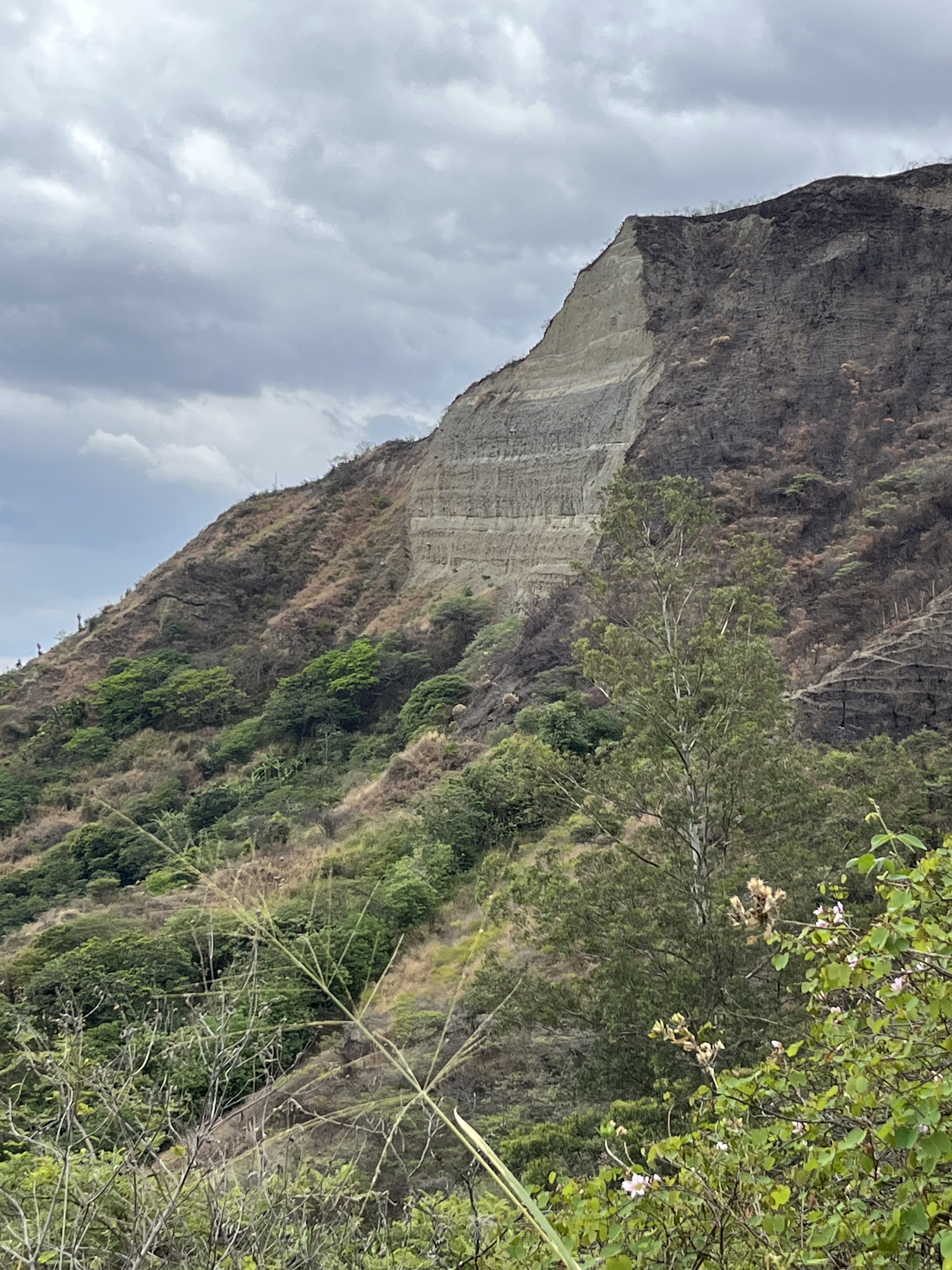 |
| A CLOSER VIEW OF THE ROCK FACE |
 |
| LOOKING WEST OUR HOUSE IS OUT THERE SOMEWHERE |
 |
| A CLOSE UP SHOT OF WHERE THE FIRE WAS |

How is Buster doing, you might ask? He is doing well. He no longer has an ear mite problem. But after that was resolved he kept getting scabs to his face or neck. At first we thought this was due to him colliding with the thorny bushes here, and maybe some were. But later on we learned he has been fighting with another large male cat at night. One scab became infected, so we gave him a bath in the sink, scrubbed him very well, and applied certain topical creams. So far this has helped a lot, and he has become a happy camper. We make sure he is in by the time we go to bed (09:00), but he usually wants out about 4-5 AM. We think he gets bored now and then, and fortunately we will be acquiring the neighbors dog, since her owner is moving to Mexico and cannot take the dog along. I can’t remember the mix of breeds, but the dog is very obedient, gentle, and smart - and she likes cats! Amazingly when the dog was brought for a visit, Buster could sense that the dog was not a threat, and stayed nearby. This happened the 2nd time as well. That time the dog was left with us for a couple hours, and when we returned her to her house, the dog followed us back down the hill to the gate, as if she wanted to come back to our house. We suspect due to the packing and what not going on at her house, the owner does not have much time for her now.
 |
| HE HAS CLAIMED THE SPARE BEDROOM AND BED |
 |
| FAT AND SASSY |
 |
| SMALL TABLE OR BIG CAT? |
 |
| EATING COCO CRACKERS. HE HAS GOOD TASTE |
Quality Control: In the USA when we buy everyday type items, we assume they are in good shape. And if they are not, we return them for a refund. Well……….things are different here. Many items are made in (another drum roll please…………..) China, and the quality is often unsatisfactory. And, there are no returns. Here are a few examples.
The small plastic containers one buys to put food in to keep in the fridge are a far cry from the “Tupperware” brand. The lids crack easily, and so it may be hard to remember to go easy when putting them on. And some don’t even fit snuggly!
I bought a rake one time, and when I went to use it, the wooden handle came out. One would think it would come with a screw to keep the handle attached. I put one in.
Not long after we moved to our new house, we made a trip to Loja, and at the local large “Costco” like store (Kiwi) I purchased > $500 of tools, such as I would need around the house. A socket set was certainly in order, and when I opened the lid to get one, a plastic hinge on the back side broke off.
Another tool I bought was a shovel. What person living in the country does not have a shovel? One chore I needed a shovel for was burying the food scraps. I chose an area do start these bi-weekly jobs, and when I put my foot on the shovel, intending to dig into the hard ground, the shovel bent/flexed! I suppose it is a good thing to find this out early so that I would not use it for a more difficult job.
We wanted to replace our front door with a metal one for added protection. We knew of a “builder” who apparently did a nice job for some friends as he built their entire house. He also spoke English. So we told him what we wanted, and he assured us the door he’d put in was solid metal, heavy, and bulletproof. We wanted it to open to the outside, with the handle on the right side. Turns out the door is light weight, certainly not solid or bulletproof, handle on the left, and opens to the inside. After a month, the trim is still not done…….go figure. Before this we did consider hiring a local “builder” who spoke no English. But after some mis communications, we felt it best to not use him. Thankfully the builder we used for our porch/patio is Canadian and speaks English, and does what he says, and his crew put in two very nice metal doors.
The first “builder” referred to above told me where I could go to get paint, as I needed to do some touch up work both inside and out. The store was said to be like in America, where you take a sample to the paint store, they can match it and mix the paint right there. So I went to this store, only to find out they only sell paint in gallon containers (plastic) and do not mix to specs. So I’ve had to do that myself, trial and error. Later on I needed some gray colored paint, so bought a liter at the local hardware store. When I got home, I opened it and it was thick as paste. Simply unusable. In hind site, I am wondering if I was expected to use paint thinner with it? Shortly after that I needed more paint for inside wall touch up, and my groundskeeper told me of a place that actually does mix and match, which turned out to be on the same road we live on, but almost to town.
A few months ago while awaiting our meal to be served at a restaurant, we began munching on the chips. We figured out the chips were made from sweet potatoes. They were really good, probably deep fried in oil and liberally seasoned with salt. Not healthy, but they sure tasted good. Shortly afterward we saw some in the grocery store and began buying a bag about once per month. However, when we opened a bag recently, it was soooo rancid we just dumped them in the food scraps bucket, never to buy them again.
Speaking of the food scraps bucket - it was getting full the other day, so I took it out to the food scrap graveyard. After digging the hole and emptying out the contents, I noticed a few tomato peelings stuck to the the bottom, so banged the bucket on the ground to force them out. By now I should have known better, that the Chinese plastic here is cheap and brittle, and the ridge on the top cracked. It is still useable, but for how long?
A couple weeks ago I lost the prime in the water line for our irrigation water. Wilson, our groundskeeper, suggested I replace part of it with a bigger diameter plastic pipe. So we went to town, got the necessary supplies. I estimate that the current black plastic piping is some 350 meters from the small water impoundment which our community uses. We would replace the lower 100 meters. When we dragged the end up to where it needed to be, we determined the problem: a squirrel had chewed two holes in the old pipe, and water was trickling out. Sure wish I had my pellet gun…….. Due to the larger diameter pipe, the pressure is better. I also had Wilson rearrange the sprinklers so that everything is watered more adequately. After another month I noticed that the pressure in the irrigation line was low, so went to see if there was more squirrel work done, and sure enough, water was spurting out a small hole. I decided to buy some thin PVC pipe and slide it over the black plastic pipe. So far so good. I don’t think he can chew through PVC, but we shall see. Now that more time has passed, and I have other problems with the water line, I decided to re-route it a different way to our house. None of it hangs over the ravine where the squirrel lives, and so far it works very well.
Before moving I went to the local T-mobile store to inquire about their service in other countries. They (and Verizon) told me I will have 6 months of service, and then they cut me off. So we’ve been asking others what they use here and how they keep their old number. Sometimes your old number from the states is so tied into other entities that it is crucial to keep it. We have decided to use the magic jack system - not for the jacks, but because they now have an app by which all calls and texts which would have went to your old phone number, now go to the app. The flip side is that we also needed to change to a local Ecuadorian number and service. There are some minor deficits to both, but doable. So with my old # I can still text and call and vice-versa, but cannot be part of group texting, nor can I send pics that way.
We were glad to get internet service right away as we did not want to be without such. However, it has been inconsistent. When I went to the office after a month to pay for the next month, I had the password changed to something less generic. But when I got home, it did not work. As we needed to return to town for something else, I returned to the office and straightened it out. When home it did work, but one of the ports on the router was now turned off. This was determined because later that afternoon the person who set up our alarm system came over to finish a few details. He is truly a tech geek, and was the one who determined the problem with the router. He said he does not trust this particular Internet service. He said there was absolutely no reason to turn off that port. He called the office to get it turned back on, something needed for the alarm system he has installed. Shortly after that, the modem was not working at all, so we had that replaced. We did consider getting a different internet provider, but in the end stayed the course with the current one. They did come out and added another, stronger router, and so this seems to be working well, for now.
One “trick” here that some use to make money is to sell fake honey. There is a guy in town who does so, and we’ve been warned about him. He has approached us a few times, urging us to buy his honey. There is another guy in town who I see occasionally. He is a panhandler, always asking for money. I remember him from when we were here some 20 months ago. It seems everyone else at least makes an attempt to support themselves selling something or at least finding a job, however menial. I even saw this guy panhandling in Loja, some 25 miles away one day!
If you speak Spanish and need to call 911 for an emergency, your call first goes to Quito, some 350 miles to the north. They in turn make a call to the city of Loja, just 45 minutes to the north, who in turn calls Vilcabamba. The process is said to take about 45 minutes. But you can call the number for the local police for an emergency and bypass the aforementioned. But, they may ask if you will pay the taxi fee for transportation to where the emergency is. They don’t always have a vehicle to use. They are quite low paid, so it is common for them to overlook certain problems for a bribe. Guns are illegal here, so communities tend to band together to get creative in looking out for each other.
Speaking of the police, the other day I saw one run a stop sign. This was a regular police person in a cop car. They are different than what are “Transit Police.” The Transito Policia only deal with traffic, while the regular police only deal with crime issues, and they rarely or never infringe on the other’s responsibilities. After asking around, no one knows of anyone who has ever gotten a speeding ticket.
The other day I cut a bunch of bananas away from the stalk of the tree. When that happens the “sap” drains out of both the stem of the banana bunch and the tree (or is it plant?). As the tree only bears one bunch, it is customarily cut down afterward, which I did. I drug the tree over to the burn pile, dragging it across the new back patio. The tree oozed a few drops of the brown liquid on the patio, and I did not think anything about it. However, a few days later I was power washing everything as a clean up measure now that the porch work is done, and guess what? Those brown stains did not come off!. (Are you kidding me?). Luckily the former owner left some kind of acid cleaner. I had tried it once before on some bat crap, and noted it was soooo strong it dissolved the grout between the tiles! So I gingerly put some on the brown strains, came back in 10 minutes and power rinsed it off. As an aside, whenever a banana tree has been cut down, our cat Buster rubs his neck in the exudate, and his white fur turns brown, and he then has a peculiar aroma about him. Not sure what the appeal is, but he enjoys it immensely.
On Wednesday, September 11, we went to Loja as I needed a skill saw and some other small items, and Rosie needed to do some shopping. We had some tentative tenets for another week, who wanted to go to the city as well. While waiting outside the “Fruit and Nut” store (Rosie’s favorite) who should walk by but Ulises, our Visa agent. We had not been in contact with him since he completed our legal work on May 28. In a city of 200K, what are the chances of running into him on the street? We had a nice chat for some 20 minutes. He also thanked me for referring Russ and Mary Baty to him as they were needing to start the process of obtaining their permanent Visa. He said he’d need to go to Cuenca a few times soon, and could in fact get our wedding certificate registered while doing other business there. This is a great convenience for us, and something that needs done before we become permanent residents. He said he would give us a discount for referring the said couple to him. Nice to know people……..
There is a young couple who attend the same church we attend, who were engaged to be married. I guess they took a liking to us, and invited us to the wedding, which took place on September 15. It took place in the huge lobby of a hotel, which was over 100 years old. Rustic is a good description. There were 60-70 attendees, and we felt honored to be the only foreigners there. In the Latino culture affections are shown much more freely. It was a meaningful experience.


Now that things have settled down and we are more relaxed and caught up with those necessary things involved in moving here, I finally have time for some birding jaunts. Not knowing or being familiar with the geography here can be daunting, but for some it is a great opportunity for exploration. So long as the car is dependable with good tires, I see myself pushing the limits. Some of these exploratory trips you will read about in the future, at least the ones that go well………. Here is a pic of where we went to on Cerro Toledo. The road continues along this ridge, and a 4WD is a must! I’d like to walk this road sometime for a mile or so.
 |
| GREAT SCENERY! SOME “ROAD,” DON’T YOU THINK? |
 |
| THE ONLY RELIABLE 4WD UP HERE! |
On October 13, I took our neighbor Chris over to the Catamayo area birding. This is the small city where the local airport is. In exploring the west side of town, I saw 2 Eastern Kingbirds, a new species for my Ecuador list. The next day, after returning from our morning walk, I was sitting on my porch and saw one of these same birds in the neighbors yard. I quickly snapped a pic, but when I began moving closer, the bird flew off. I noticed something odd about it, but passed it off as nothing important. I email a pic of him to my birding friend John in town. He must have been busy with his work, and since the electricity was off in the afternoon, I was not able to see his response til late. When I did, he said it was a “Fork-tailed Flycatcher!” Wow! And after I looked at my photo better, I can see the long tail. A lifer from my own back porch, and one of those dream birds I was hoping to see some day in Ecuador. Simply unbelievable!
 |
| FORK-TAILED FLYCATCHER |
I’d better bring this to a close. In about a month I will send out my best bird pics for 2024. Here are a few misc shots to end with.
 |
| WE PAID $13.60 FOR THIS HAUL |
 |
| DOG AND CAT. A MIRACLE AS BUSTER HAS BEEN TERRIFIED OF DOGS. |

 |
| BAND-TAILED PIGEON HANGING UPSIDE DOWN. MAYBE THEY ONLY DO THIS BELOW THE EQUATOR? |
 |
| FOR 2 WEEKS WE WERE BLESSED WITH 2 SMALL TREES OFF OUR BACK PORCH WHOSE BLOSSOMS BLOOM ONLY AT NIGHT. THE FRAGRANCE WAS SUPERB! |
 |
| THERE WAS A LINE OF ANTS HEADING BOTH WAYS ON THE WALL OF A RESTAURANT WE WERE. I SCRAPED SOME CHOCHOLATE IN THEIR PATH, AND THEY WOULD NOT CROSS IT. GUESS THEY DON’T HAVE GOOD TASTE. |
 |
| RAINBOW AT OUR PLACE |
 |
| RED-BROCKET DEER ON CERRO TOLEDO |
 |
| EATING STRAWBERRIES AT THE MARKET |
 |
| THIS WAS ON THE BACK OF A BUS. WHAT LABEL WOULD YOU ATTACH TO IT? |
 |
| SUNSET AT OUR PLACE |
 |
| A GOAT FOR SALE AT THE MARKET |


