Thursday, February 2, 2023

ECUADOR BIRD PICS # 7

AS WE WILL BE LEAVING VILCABAMBA TOMORROW, HERE ARE THE REST OF THE BIRD PICTURES FROM HERE.  A FEW ARE REPEATS OF THE SAME SPECIES, BUT OF BETTER QUALITY.

                                                    RUFOUS-BROWED PEPPERSHRIKE


                                                            PALE-LEGGED HORNERO


                                                                WHOOPING MOTMOT

                                                    MALE GLOSSY-BLACK THRUSH


            FEMALE GLOSSY-BLACK THRUSH - LACK OF EYE RING HELPS ID MALE/FEMALE


                                                                        EARED DOVES


                                                            LONG-BILLED STARTHROAT


                                                                WHITE-TIPPED DOVE


                                                                GIANT COWBIRD


                                                                    BLACK VULTURE


                                                                GROVE-BILLED ANI


                                                                   SHINY COWBIRD


                                    YELLOW-TAILED ORIOLE WITH NESTING MATERIAL


Tuesday, January 17, 2023

THE MAYCU RESERVE

Just up the road from Yankum, going south, is the Maycu Reserve.  I’m not sure if it was set aside because of the rare tanager discovered there in 1964, or if it was already in place before its discovery.  


Either way, it is a unique place, and the road which goes through it is the easiest way to access a small part of it.
  We ended up going here for the first two mornings with Christian, then just Christian and I the afternoon of the 3rd day, and for 2 hours on the 4th day - me and Carlos.  Carlos offered to take me there the evening before our last day, so I thought it best to oblige him, as he must have taken note of my birding obsession, and I sensed that he wanted to take me there, although I am at a loss as to know the reason other than he likes doing such for birders.


After crossing the bridge and leaving the Nangaritza River this road goes uphill for about two miles and then gradually goes downhill, and only goes about a mile through a small part of this large reserve,  most of which is inaccessible.  The forest is full of trees and vines and the undergrowth is really thick.  


There are 2 trails which ascend “up” to the top of the nearby tepuis, which is where there are a few other species which don’t often descend as low as the road, one of which is the Royal Sunangel, one I’d love to see,  but did not want to expend the energy for the required 2 hour uphill hike.   Carlos said he has done it 5X. 


On January 5, our first full day in the area, Christian took us here.  We ate at 5:30 and were on the road at 06:00.  When we got there the birds were singing merrily, but as it was not quite good light yet, we were seeing mostly silhouettes.  But in about 20 minutes Christian heard them, the Orange-throated Tanagers, the species the reserve protects.


                           ORANGE-THROATED TANAGER - A LITTLE BLURRY


We soon saw a few, but they stayed high in the trees, but certainly a flashy bird and it is easy to see why some come all the way here to see them.  We saw 3 species of Trogons: Green-backed, Amazonian-white Tailed, and Blue-crowned.  Two birds high on my list were Lined and Fasciated Antshrikes.  Both were heard now and then, but only a pair of Lined made an appearance, and the female allowed a pic.


                                        LINED-ANTSHRIKE- FEMALE

A little later on a Purplish Jacamar “finally” showed  after numerous playbacks.  He stayed put on the power line for a good 5 minutes, allowing me to maneuver for pics at different angles.  He seems a little ragged, but that is the way he is suppose to look. 


                                                    PURPLISH JACAMAR


Just after that a Dark-breasted Spinetail played hide and seek with us, only allowing 1-2 second glimpses, so certainly no pics.  Another lifer which was fairly common were the Lemon-throated Barbets.  Most of the ones we were seeing were females, but a flashy male finally showed well.  Other lifers were Fulvous-shrike Tanager, Slaty-capped Shrike Vireo, White-eyed Tody Tyrant, Duida Woodcreeper, Olivaceous Woodcreeper, Lafresnaye’s Piculet, and Glittering-throated Emerald.  For those of you who are not birders, these names will be truly  foreign to you. 


We tallied 60 species.  I am sure I did not list all of them, especially if I was already familiar with them.  I was not going to part with birding to look down at my iPhone where they’d need to be recorded. Sometimes it took an hour to move 200 meters because the birds were always around.  It was a fun morning. 


We returned again the next day for about 2 hours before traveling farther south.  The birds were not as active as yesterday, and I was even more lazy about recording them all.  The lifers were Thrush-like Wren, Ecuadorian Tyrannulet, Gray-tailed Piha, and Foothill Stipplethroat.  Looking over my checklist I see I only tallied 3 tanager species, proof that I was lazy since there were plenty of others.  We  saw the Orange-throated Tanagers, but once again they stayed up in the tree tops.


After 2 hours of mozying along the road, we set off toward the village of Shaime, planning to bird along the 2 mile stretch of road prior to reaching that town.  The road actually goes into Peru for a few hundred meters, so I had Christian stop there so we could place our feet on Peruvian soil, and bird for 5 minutes to acquire a short bird list for that country.  


Soon after that we parked and then walked along the road.  Some of the birds we saw/heard here were White Hawk, Black Caracara, White-bellied Pygmy Tyrant, Smooth-billed Ani, Double-toothed Kite, Little Woodpecker, Thrush-like Antpitta, Piratic Flycatcher, Scaly-breasted Wren and Yellow-bellied Dacnis.  


                                ROADSIDE HAWK, THE MOST COMMON RAPTOR HERE


NO TRIP TO THE TROPICS IS COMPLETE WITHOUT A BLACK VULTURE.  THEY ARE ALL OVER THE PLACE.


                                                        SMOOTH-BILLED ANI


                                                            WHITE HAWK


                                                YELLOW-TUFTED WOODPECKER


                                                DOUBLE-TOOTHED KITE

It was all basically downhill, and when we had gone far enough Christian went back to get his truck, in which time we saw a Cocoi Heron, which I did not think was a big deal as it was not flagged as rare in eBird.  When Christian arrived I told him about it, and he was all excited asking “where, where,”  as he had never seen one in the Zamora province.  I had seen the heron across the river flying over some small ponds, but did not see where it landed, so we could not relocate it.  It was like a state bird for the listers I’m familiar with, and he had come mighty close, but missed it. (We went for a boat ride up the Nangaritza River later that day, and we saw another one, so he was ecstatic about it). 


On the 3rd day we returned in the afternoon, just Christian and I.  It was a finale of sorts as the birds were thick and we moved rather slowly, and spent at least 3 hours there.  What made it special was that some were more compliant in posing for pics this time.  One let down was no Orange-throated Tanagers.  I tallied some 58 species, but am sure some were missed.  Lifers…….Gould’s Jewelfront (A really spiffy hummer), Ivory-billed Aracari, Peruvian Warbling-Antbird, Brown-billed Scythebill, Olive-faced Flycatcher, Sooty-headed Tyrannulet, Golden-bellied Euphonia, Flame-crested Tanager and a flock of about 100 Black-and-White Seedeaters.  


                                                        PERUVIAN-WARBLING ANTBIRD


                                                    GOLDEN-COLLARED TOUCANETTE


                                                                    BLACK CARACARA


                                                                    LINED ANTSHRIKE - MALE


                                                            GREEN-BACKED TROGON


                                               AMAZONIAN WHITE-TAILED TROGON


Soon after we returned to the lodge, Christian went home.  It was great having him guide us.  He knew all the birds by sight, and almost all by their voice.  With my fading sense of hearing I’m certainly at a loss in this country.  After he left Carlos offered to take me back up to Maycu the next morning before breakfast.  I really was hoping to sleep in but my instincts told me to accept his offer, so we took off in his van at 06:00 the next morning.  Being 71 his hearing and vision are still in great shape.  He knew right where to stop for the Orange-throated Tanagers, and in about 10 minutes he heard them.  They were on the downhill side from us this time, implying that, while they were still in the treetops, at least the trees were lower on that side of the road.


In a couple minutes they began coming our way, and even came lower in the canopy.  My camera now came to life and sounded like a machine gun at times as I wanted to make every opportunity count.  Am sure I took at least 100 pics and more like 150+.  Most were to be deleted, but one group was clear and worth keeping.  (I had obtained some the first day, but they were blurry).  I am becoming a perfectionist with photography, so always hope for the best.  Another bird he heard and finally got me onto was a Musician Wren, my last (heard only) lifer. 


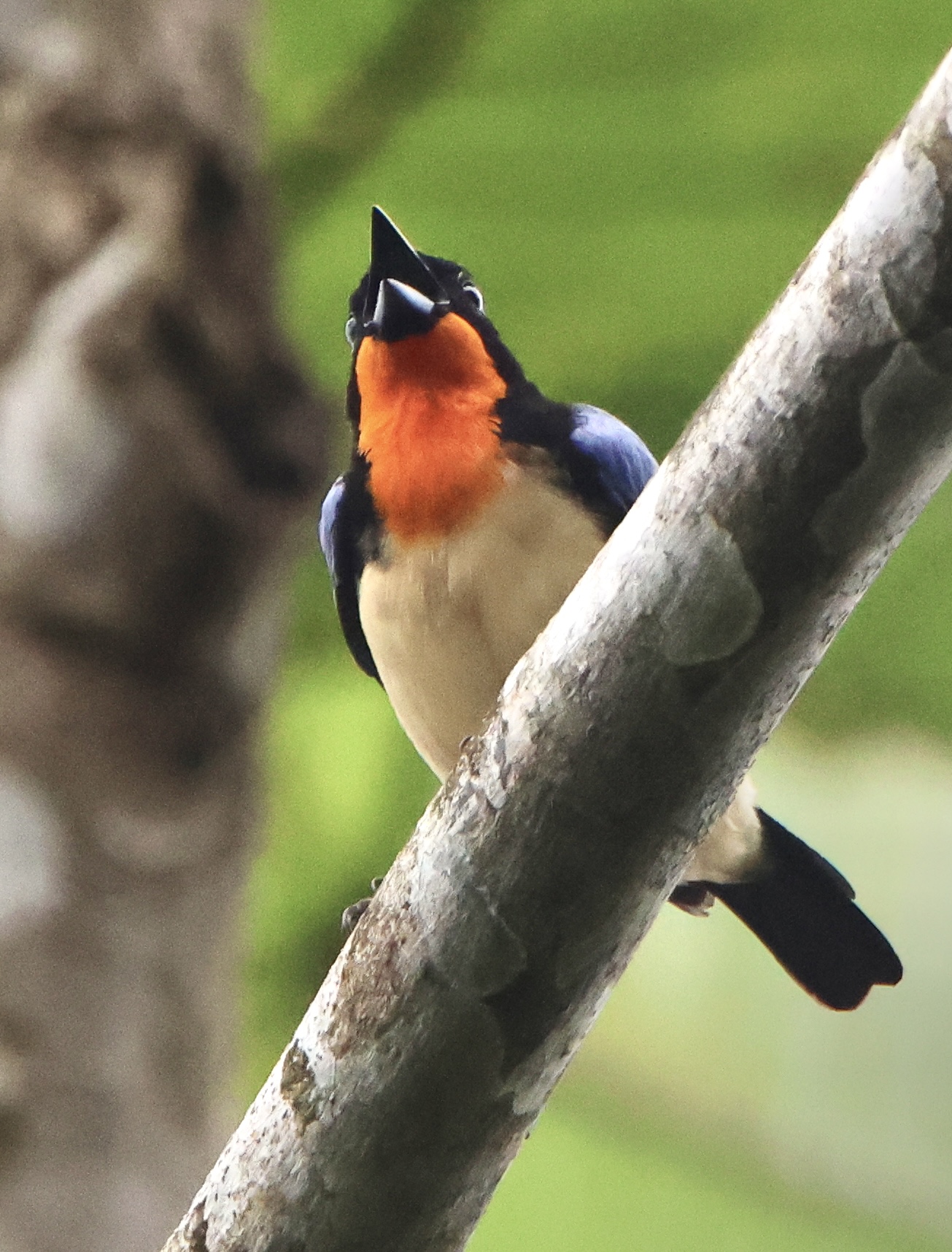
                                        ORANGE-THROATED TANAGER


Our 2 hours were soon up and we needed to head back for breakfast, but just down the road Carlos pulled over and said “Aracaris” and told me to get out.  There was a group of 4 Chestnut-headed Aracaris having some kind of tussle, and were squawking up a storm, so here is my best shot of one.


                                                CHESTNUT-EARED ARACARI

And so ended my visits to Maycu.  I recorded 101 species there in those 4 visits. What a place!  I’d return anytime.  Christian said there were a lot more species we potentially could have found.  As a matter of fact, on that last visit when he went back uphill to get his truck, he saw 3 species, 2 of  which would have been new for me: Fiery-throated Fruiteater,  Masked-crimson Tanager, and Rufous-rumped Antwren.  Such is birding; always full of surprises.  


Monday, January 16, 2023

THE RIVER GORGES

                                                                     January 6, 2023

After birding with Christian again this morning we returned for lunch about 12:30, and ate a few minutes later.  During lunch I asked Carlos if we’d be taking a boat trip after lunch, to which he said yes.  I had asked his wife and his worker yesterday if there might have been enough rain to raise the river enough to take boats upstream, and his worker said yes.  I did not realize he’d be at the helm.  


So after the meal Carlos set us up with sun hats and life vests and we walked down to the river.  


                            FASHIONABLE HATS AND LIFE VESTS WERE RIGHT IN STYLE


                                    CARLOS AND HIS TRUSTED WORKER


His worker was doing something with the motor, and then he bailed the rain water out of the boat.   I was impressed when the motor started on the first pull, and looked over at Carlos, who had a big smile on his face, as if to imply, “We know how to maintain our motors here.”  So in we hopped, and were soon cruising upriver.  Having been on many canoe trips on rivers before, I could sense this would be a fun adventure right away.  


I’d been noticing that the water was brown and wondering if it was due to the gold mining upriver.  I later asked Carlos about it, and he said yes, it “was” due to mining. (I also asked him how much longer the mining would be going on, and he basically said for many more years).  It only took a few minutes to reach the bridge we’d now been over a few times, and not much farther along we spied our first bonus birds - a pair of Channel-billed Toucans.  


                                HERE IS THAT ROYAL TOUCAN AGAIN


They did not pose for pics, but did impress us when they flew across the river in front of us.  Not long after that we were in “Encanonado de Miazi,” or, Miazi Canyon, with such steep sides you could strain your neck looking up.  This was where we spied the best species of the trip - a pair of Cliff Flycatchers.  These were  lifers for me, and here is a reasonable pic.  I should mention that taking pics from a moving boat was a challenge, but I managed a few good ones.


                                                CLIFF FLYCATCHERS


Occasionally we’d flush either a Green or Ringed Kingfisher.  It was a little reassuring that these birds were still around with all the gold mining above and below this area. It was also nice to not have to view where mining had taken place.


                                                            GREEN KINGFISHER


                                                            RINGED KINGFISHER


                        THE SAME BIRD AS ABOVE, A FEW SECONDS LATER


The scenery was spectacular!  Wherever the sky opened up you could see the nearest tepuis, mostly flat, table-top mountains, the sides of which were mostly vegetated, but a few had a bare rock edifices.  Christian had told me there were a few species of birds on the tops of the tepuis which required a strenuous hike, so those lifers were just not on the “table” for me.  


                                                        THE STEEP CANYON WALLS


                                                            NEARBY MOUNTAINS


                                        HEADING INTO THE FIRST CANYON


Another interesting bird was a Cocoi Heron, very similar to the Great-blue Heron in the states.  


                                                    COCOI HERON


                                                STRIATED HERON


Rosie and I had seen one earlier in the day farther upstream, but Christian was not with us at the time because he had walked back up the hill to get his truck.  When he returned I told him about it, and he was all excited, saying he’d never seen one in the Zamora Province.  I felt honored to have seen a rare bird, but sad for Christian for having missed it.  We looked over where it was seen, but did not find it.  So,  flushing one on the way upriver was special, and we were happy for him.  He stood up in the moving boat, put his hands together and bowed in a thanking gesture to the bird for obliging. 


Between the first and second canyon there was evidence of recent gold mining, with plenty of river rock piled up here and there.  Talk about a spoiler.  It was also obvious that the mining had changed the course of the river here and there, dividing the current in 2-3 places at times, which tended to be shallower than one main channel.  A few times we had to figure out which way to go.  In one wide spot the driver turned the boat to shore, and we learned this was the place where there were some Hoatzins, a large turkey-like bird found only in the Amazon lowlands.  Our guide got out to see if they were nearby, and I figured he’d be gone for a few minutes, but he never left our sight.  He said they were here, and we saw them hanging out in 2 trees.  Here are a few pics of them.  The former inhabitants of these lowlands did not eat them as their meat was said to be quite foul, no pun intended.


THIS GUY WOULD CERTAINLY BEAT THE UMBRELLABIRD AND COCK-OF-THE-ROCK IN A HAIRDO CONTEST


                                                                    HOATZIN


We eventually reached the second canyon named, “Encanonado de  Shaime.”  This one was more narrow than Miazi, with steep sides as well.     It was simply magnificent going through it.  Occasionally a small streamlet  could be seen coming down the side of the canyon.  I wish I could describe it well, but words fail me, so these pictures will have to do.


Out the other end of the canyon the results of the mining were more widespread.  We did not go very far into that area as the choices of the different riverbeds did not leave us that option, being too shallow for our boat to make it farther.   So we turned around and headed back toward the canyon for another cool trip through it.  We’d be going downstream now with the current and the sun at our backs.  On the return trip the boat scraped the gravel on the bottom once, so whatever might have been growing on the hull was no longer there.


I began to think about the cost of this trip.  I had asked Carlos yesterday and I was pretty sure he said $19.00 (in Spanish of course).  I assumed he meant nineteen bucks per person, but having seen these nice canyons, I began to wonder if I misunderstood him.  Maybe it was 29, 39, or 49 bucks per person?  I just knew there was a nine - “Nueve” in his response.  


The trip back took probably half the time  going up.  Our driver/guide was pretty skilled at maneuvering the boat.  He had to plan for how fast the current was going and what objects to avoid and how to steer that long heavy steel boat.  


We made it back OK and disembarked, very thrilled with the experience.  Back up at the dining area I asked Carlos to remind me what the cost was, and he said $19.00, “total.”  My jaw almost dropped open, but I guess they live on a different pay scale here, and fuel is around half of what it is in the states now.  I decided that when we pay our fare here I’d leave a tip for the driver (which I forgot to do).


The mining is a huge eyesore for this beautiful area.  At least some people like Carlos said “NO” to the entities who offered him big bucks to dig up the riverbed adjacent to his place.  Most will take the nice chunk of  money and endure the ugly sights as it also raises their standard of living by offering good paying jobs, so you can’t blame them.  It was just great that a small portion of the river is left undisturbed, and Carlos is making his living in the tourism trade, something he loves to do.