Friday, January 13, 2023

BOMBUSCARA

January 3 found us up at 5:30 to get ready to meet Christian Romero, our bird guide for the day (and also when we will be at our next place -Yankuam ).  At about 5:50 the town below irrupted with horns and loud speakers blaring, so once down on the street we were greeted by a long line of vehicles and people waving Zamora flags.  Christian later explained to us that it is nearing election time, so the various candidates have their followers promoting the cause they support.  Christian was out there to greet us also, and we loaded ourselves in the front seat of his pickup, and struck out toward our destination for the day- the Bombuscaro entrance to Podocarpus Nat Park, named after the river already mentioned.  


Along the way we saw a Magpie Tanager, our first for the trip.  We learned that Christian has a degree in Aeronautical Engineering. I was puzzled as to the need for such in the jungles of Zamora, so asked him about it.  He admitted he does not use it, but is into the commercial aspect of cocoa.  He lives about 45 minutes away near the town of Yantzaza and owns 5 hectares of land with a house, and hopes to make it into a birding lodge of sorts.  He explained that he is centrally located between Copalinga/Podocarpus, Yankuam/Maycu and the Zarza Reserve, all great places to bird.  Plus, his own land which he has named “My Paradise,” is worth a stop.  He is hoping to leave the cocoa business in 2 years and strike out on his own.  He already has a great reputation as a birder.


We reached the end of the road and the entrance to the Park.
  One must realize that, especially here in the jungle, it is important to get out and bird early since birding activity dies down the hotter it gets.  Like Walter, Christian knew all the birds by sight and song, so it would appear nothing would get away.   The sun was not yet very high in the sky, so we would be looking at silhouettes for a bit, which meant I did not use my camera until we reached the HQs, about an hour of walking at our pace. 


Some of the first birds we saw was a flock of White-eyed Parakeets, a lifer for us. Wherever there was a cut bank Christian would look for Jacamar nests and where Parakeets scraped for minerals to ingest.  Jacamars dig a burrow entrance to their nest, and he shown a light into one with his cell phone, and we could see the miniature chicks in the back.  The parents of a few nests would not come around to playback, until we reached the pair near HQs.  At some places on the cut banks were scrapes of various sizes.  He explained that these were made by the local parakeets who were eating the hard dirt here to add minerals to their diet. 


                    AN EXAMPLE OF WHERE PARAKEETS SCRAPED THE EXPOSED BANK


                        THE WHOLE IN THIS PICTURE IS A JACAMAR NEST


It took us an hour to reach HQs because we stopped often for birds.  Once there we heard both a Cock-of-the-Rock and an Amazonian Umbrellabird, the males of both with hairdos that will raise your eyebrows.  Christian chose to play the Cock-of-the-Rock “song,” a truly guttural annoying sound, which worked like a charm.  Two males came in immediately, and here is the pic of one.


                                        COCK-OF-THE-ROCK - MALE


The Umbrellabird took a little longer, but a male did come - a lifer for me.  This is not the best picture, but it will have to do.  The males have an inverted crest,  often called the “Elvis Presley” hairdo, which hangs almost over their foreheads, as well as a “wattle” which hangs down from their chest.  They sound like a foghorn in the distance.  My camera actually detected his yellow iris!


                                        AMAZONIAN UMBRELLABIRD    


Next up was looking for the Coppery-chested Jacamar.   Christian could hear one in the vicinity, and after taking a couple trails for very short distances, one finally came in to playback.  A female.  Here she is. 


While jockeying around for a better photo angle, I almost upset a wasp nest.  Here it is:


We walked a couple hundred meters down one trail coming across a group of Green Jays, but the battery on my camera was dying out and one of my settings was off a bit, so I did not get decent pics.  The next trail we opted to take was the one to the waterfall, but first we decided to eat breakfast.  After sitting at a table at HQs we noted some of the staff arriving, so Christian went and got the sign in sheet, something I doubt they ever look at - mainly a formality in case someone gets lost.  One of the few times we actually needed copies of our passports for the numbers.  I could just as easily have gotten those off my iPhone.    


The sign for the waterfall trail said medium difficulty, which we had our doubts about after looking at how steep it was.   But after reaching a certain part, it leveled off and the rest was pretty flat.  The best bird along the way was an Ashy-throated Chlorospingus, a first for the trip.  When we reached the waterfall Christian dunked his head in the water to cool off.


The waterfall was a picturesque place, and we certainly took our share.  After getting back to the hotel I noticed a picture in the hallway of this same waterfall.  


                                    HERE’S A PHOTO OF THE REAL WATERFALL


                                    HERE’S THE PIC ON THE WALL OF THE HOTEL

When we were almost back to HQs, Christian heard a Lemon-browed Flycatcher.  I told him it would be a lifer, so we hurried to HQs where the canopy opened up, and he played the appropriate song.  The bird came right in, allowing views and pictures, but stayed up on the tops of the trees, so we did not have the best of views.  That would change at Yankuam. 


We descended the hill upon leaving HQs and at the bottom of the ravine was a small creek.  When we were reaching HQs a couple hours ago, Christian had played a bird song of which I never did understand which one, but he was playing it now and getting a response.  Finally the bird came partially out into view, at least from my angle, and he kept on singing even though Christian had stopped using his phone for such.  I got some good pictures, and suggested he come to where I was to obtain the same.  But he suggested I come over where he was.  After comparing pics, he could see mine were better, so he came to where I took mine, and got the pics he needed.  It turned out that the bird was an Olive Finch, and  lifer for him!   Amazing.   Sometimes these skulkers stay so hidden that even the guides rarely see them. 


                                                        OLIVE FINCH


Even though it was getting hotter, the birding was still pretty good at times.  A small flock yielded both a Black-faced Dacnis and a pair of Yellow-breasted Antwrens, the latter a lifer for me.  Shortly after that we had a good sized mixed flock that was hard to surround as far as IDing everything.  Tanagers accounted for were Paradise, Orange-eared, Golden, Golden-eared and Green-and-yellow.  I spied a couple brown birds and finally got Christian on them - Ash-browed Spintails, another lifer for me.  


                            BLACK-MASKED DACNIS


Finally we made it back to the truck and Christian opened the windows.  The front seat was really cooking, so I dug out a shirt and used it for protection.  It was now really hot, and Christian would have continued guiding us, but we were content and did not want to push the limits of our endurance for heat.  In the motel lobby we made final arrangements for our time at Yankuam, a place he says is really great birding (so long as we can handle the heat I think). 

Thursday, January 12, 2023

COPALINGA MONKEY BUSINESS

The Copalinga Lodge has been around for some 20 years, and was created mainly for birders. Originally owned and built by a Belgian couple who sold  to the Jocotoco Foundation, who now manages it.  After we were finally in the country, I completed my plans to visit a few areas on the east side of the Andes, Copalinga being one of them.  I’d been reading bird reports from this lodge for years, so knew it to be a place I wanted to visit some day.  Not knowing what to expect, I had Hernan take us there prior to getting to the hotel, but the gate was locked.  So I climbed through the barb wire fence and went up to the lodge area, knocked on a few doors, but no one was around.  After all, it was New Year’s Day……


At 07:00 the next day we took a taxi there, and the driver showed us another, smaller gate which was open, so we paid him the $3.00 and went in.  In the restaurant area we met Walter who seemed glad we were there.  He did not speak English so, after our experience at Tapachilaca I felt I ought to show him the reservation notice I had on my phone.  He then asked what time we wanted to eat, and we told him 10:00, so I figured there would be no mis communication this time.  The cook later came out and asked us the same thing, and we changed our minds and made it 11:00. 


Walter came out with us to the immediate lodge grounds and showed us a few birds.  We hung around there for about a half hour before embarking on the trails.  


        THIS BRIDGE HAS SEEN BETTER DAYS.  ROSIE WENT FIRST TO TEST IT


He had shown us where a few “stake-out” birds were on the map, which I suspected we were there a little late for, and such it proved to be.   We heard many birds but were not able to ID many at all.  Plus, all the trails were steep in parts, which was a challenge for us.  The best bird by far we found was the Gray Tinnamou.   I strongly suspect this bird is one (s?) that they feed here as he allowed us to get within 12 feet of him.  I think normally they are very shy.  


                                                    GRAY TINNAMOU


By the time we were to eat we  returned to the restaurant.  I asked the cook if she could put out some bananas on the feeders, which she did.  Shortly thereafter  I spied a monkey…. and then another…. and then another.  It turned out that they were also waiting for bananas as well.  In short order one came down and swiped two of them and dashed back into the trees.  In a minute the other 2 bananas were gone also.  No wonder they don’t feed the tanagers anymore!   It was hard to estimate, but I think there were a dozen of them or so.  


                                                CAPUCHIN MONKEY


One young one stayed near the feeding station for a good half hour after the rest left, actually sobbing because he did not get any banana.  


                HERE IS THE YOUNG PUNK WHO DID NOT GET A BANANA


During our meal I noticed a movement out of the corner of my eye, which turned out to be a Black Agouti who came for cracked corn.  


                                                        BLACK AGOUTI


After lunch we walked down the road where it was flat and mostly shady.  The birds were still fairly active and a cloud cover was still helping us, somewhat.  Not far down the road was a house that had Crested Oropendula nests hanging from a tree almost over their roof, and a few of them were buzzing around.  As big as they are you’d think they would be easy to photograph, but I’ve not obtained one to my satisfaction as yet.   


                                            CRESTED OROPENDULA


We soon found a path down to the Bombuscara River.  It was a nice place to sit for a few minutes.  I looked up and down stream for dippers, but had no success.  


                                                            BOMBUSCARA RIVER


                                                    BOMBUSCARA RIVER


One beautiful bird we did see was the Bay Headed Tanager, which I hope to eventually get a picture of.  As it was getting hot and the sun started beating down on us, we decided to turn around, and shortly thereafter we found my number ONE target bird - a Paradise Tanager.  Seeing one in this location was virtually garenteed,  so it was just a matter of time.  


                                                PARADISE TANAGER


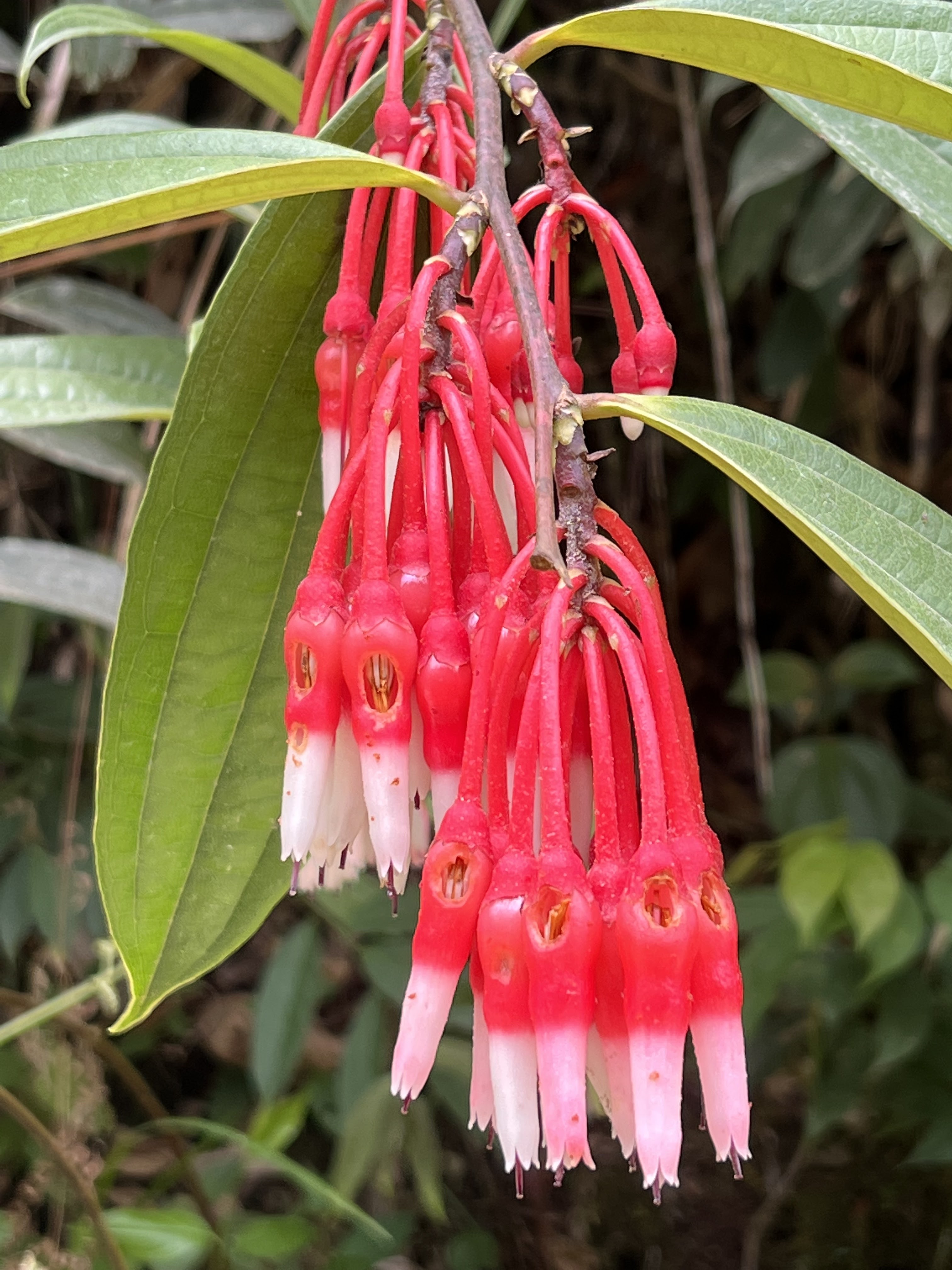
THE HOLES IN THESE FLOWERS WERE MADE BY BIRDS CALLED “FLOWER-PIERCERS.”  THEY DO THIS TO RETRIEVE THE SWEET POLLEN INSIDE


When we reached the lodge Rosie decided to hang out in the restaurant while I waited around outside for a certain hummer to come to the flowers.  We had about an hour to wait until Walter would appear and take us to feed the Gray Tinnamou, so it was a good way for me to kill time.  The hummer never did show up, but there were plenty of others to occupy my time.  


                                                        BLUE-GRAY TANAGER


        WEDGE-BILLED WOODCREEPER.  THOSE END “FEATHERS” ARE USED AS A PROP


                                                            SPARKLING VIOLETEAR


                                                    SPECKLED CHACHALACA


                                                TROPICAL KINGBIRD


Walter arrived on cue, and we left Rosie behind as she had had enough hiking for the day.  It was great to bird with Walter as he knew the birds and their songs.  He would pick one out after another.  Thanks to him I got my lifer Masked Tanager, Golden-headed Manakin and Orange-eared Tanager.  We heard and saw a few others I had overlooked earlier.  Well, the Tinnamou was a no show, so it is good that we saw it earlier.  I ended up with 54 species for the day, a few of which were lifers.


Walter called a taxi for us who was there speedily, such that we had to go into the restaurant and hastily pack our stuff.  So it was a good day, even though I missed a number of expected birds.  In hindsight, I neglected to take any pics of the lodge/restaurant area.

Wednesday, January 11, 2023

ZAMORA

                                     OVER THE HILL TO ZAMORA


On January 1st we left Vilcabamba at 10:00 with our trusted taxi driver Hernan.  It took an hour to get through Loja, and maybe another 20 minutes to reach the pass over this part of the Andes, which is just over 9000 feet.  We were in some clouds near the top which dissipated as we descended the east slope, which was pretty much all curves.  But the road was concrete and in excellent shape and the occasional waterfall marked our way, while the scenery was spectacular as expected.   


I assumed that once we reached the town of Zamora we’d be on the flats of the Amazon lowlands, but my assumptions were way off.  The only flat areas I’ve seen are next to the Zamora River in town, the one which we paralleled for the last 5 miles coming down the mountain.  It is still hilly as far as the eye can see. There are 2 rivers which meet here, the Bombuscara, which is quite clear, and the muddy Zamora.  


The majority of the buildings are on hillsides, and all are made out of concrete and blocks.  Some buildings are not painted, and one sees the usual rebar protruding from some of them.  The top floor of many is an open space with a roof which seems to serve as storage space and for hanging clothes out to dry.   Some of the roofs don’t really look like they are leak proof, and a few of the tiled roofs have a few sheets of metal roofing thereon, assumed for that purpose.  I suppose the word “Ramshackle” describes this town.  One hefty earthquake and the results would be devastating. 


When corresponding with my contacts over here, I asked a certain taxi driver named Irving which hotel he’d recommend, and he referred us to the Wampushkar Hotel, which overlooks the river from an adjacent hillside. 

From the top floor of the hotel we can see a long park which stretches along the river’s edge.   We found ourselves  gravitating to a mirador on the top floor  near the end of the day, as it was always breezy and shaded there.   On the day we arrived, many families were enjoying the park, being New Year’s Day.  Since we needed a walk, we went to check it out.  There were really a lot of birds along the water’s edge, and I missed some potentially good shots by leaving my camera in our room.


For the rest of that day and the next there was a cloud cover which kept the temperature tolerable.  But on the 3rd day, the day we went to Podocarpus Nat Park, the sky was blue, and by 11:00 it was getting really hot, so we knocked off at noon and were back in our motel by 01:00, and took showers to wash the sweat off.  Around 02:00 we walked down to the street along the water’s edge where we opted to eat at the same restaurant we ate at on day one.  Then we walked east to the bridge to see how far the park goes and found it ends just past that bridge.  We then mosied back to our room, and I opted to head up to the mirador on the 4th floor. 


                              LOOKING EAST FROM THE MIRADOR INTO THE ANDES


                                                LOOKING NW FROM THE MIRADOR


                       THIS IS THE ALLEY WE TOOK GOING DOWN TO THE RIVER PARK


                                            ANOTHER VIEW TO THE NORTHWEST


From up here we see a good portion of the river and some of the town.  Lots of folks seem to enjoy walking in the park along the river. There is a small area in the park where there is a circular area with some 20  mini water fountains in which kids play and cool off.  A nearby pool hosts the same.  


I DID NOT SEE ANY SIGNS FOR USING DOGGY BAGS IN THE PARK.  SO YOU WERE ON YOUR OWN


                    THE BOARDWALK WAS BUILT UP TO AND AROUND THIS TREE


                                        KIDS PLAY IN THE FOUNTAIN AREA

From one large tree hang 2 Crested Oropendula nests, and in another some Yellow-rumped Caciques are building theirs.  Here’s a shot of the 2 Oropundula nests and one of a Cacique’s plus  some shots of birds from the Mirador:


                                                    BLUE-AND-WHITE SWALLOWS


                                                            ROCK PIGEONS


                                                        BLUE-GRAY TANAGERS


                                                TROPICAL KINGBIRD


                                                    YELLOW-RUMPED CACIQUE


                                                CRESTED OROPENDULA NESTS

                            A CACIQUE AND THE NEST BEING BUILT

On our 4th day our time in Zamora was coming to an end.  The last morning we did not have to wake up early, but did anyway.  While this was supposed to be one of the better hotels in town, we always needed to wear ear plugs for both outside and inside noise.  The bed was quite firm, and so not real comfortable.  And you would think for such a hot environment, they’d have AC, but no.  But we survived.


The dining room was in the basement where we ate our first hotel breakfast, which consisted of eggs, toast, mango pieces, juice and coffee.  After packing we went for a walk to the riverfront park one last time, and I made sure to bring my camera.  It was already getting hot, so we gravitated to the shade whenever possible.  I got killer shots of a Tiger Heron and male Swallow Tanager, and decent shots of a few others.  


                                                            FASCIATED TIGER HERON


                                                        CHESTNUT-BELLIED SEEDEATER


                                                        MALE SWALLOW TANAGER


                                                                STRIATED HERON


We returned to our room to put my camera and binoculars in my day pack, and headed downstairs to pay our bill.  I had reserved our room via the “Booking” app with a credit card, but now I learned that the place only accepts cash.  Now that was a problem as we simply did not have enough cash for this place and the next, so I told the guy this was a big problem.  He was unfazed.  So I asked where the nearest ATM was, which thankfully was just down the road.  I went there and it was part of a local cooperative/credit union, so I had my doubts.  A security guard nearby was kind enough to assist me, but it turned out the system did not work with mine, so I asked him where another one was, which was another block away.  It had the kind of apparatus that when you put your debit card therein, it took the whole thing, like a vacuum cleaner, and you wonder if you’d ever see it again.  Thankfully when I put the card in, it asked me whether I wanted English or Spanish, so I could almost smell the money now, which was almost a minute in coming.  


When I got back to the hotel the taxi driver Irving was already loading our stuff in the trunk.  I paid the bill and off we went.  It was hot, and Irving’s AC did not really help that much, so the windows were going to be down all the way.  The concrete road was in great shape.  Irving said it would be about 3 hours to Yankuam, a place I’ve been dreaming about for years, and Irving was the nephew of the owner.  The official name is “Cabanas Yankuam” meaning the Yankuam Cabins.   I think they got on the map because of a certain tanager  found nearby in the 60s which was new to science, and a pretty spiffy one at that.


I had to brainstorm whether we should attempt to try to go all the way from Yankuam to Vilcabamba in one day on our return trip, and opted to not do so, so we made arrangements to stay here in Zamora at the same hotel one last time on the return trip.  They even put us in the same room.  Tomorrow after breakfast we take a taxi to the bus depot and get a ride to Loja, and from that depot get a ride to Vilcabamba.  Should be interesting. 


—————————————————————————————————


After breakfast we paid our bill, got a taxi to the bus terminal.  We found the sign of are bus service that said “Loja,” so did our best to tell her we needed to get a bus there.  The bus was ready to leave, and we paid the fare of $3.50.  It took just over an hour to reach the terminal in Loja, and inside we looked around and did not see any sign for Vilcabamba, so found an info booth, and the guy told us it was around the corner, so away we went and found it.  That bus was ready to leave, so I held out a handful of change and the lady took one or two coins, and we were the last ones to hop on the bus, even getting front row seats. (The bus was not very full as yet).  It took at least a half hour to get out of the city, stopping every block or two to pick someone up.  The attendant then made his rounds to collect money, and wanted some from us.  We told him we paid at the terminal, but he still needed some, and that ended up being $3.80.  So I think it cost us under $12.00 to get from Zamora to Vilcabamba.  We saved $58 by using the bus rather than taking a taxi.  Funny that at the taxi stop in Vilcabamba Hernan was there in the taxi line.  I did not recognize him with his sunglasses, but Rosie did, so we had a short chat before he drove off.  So it was about as painless as possible returning by bus.