Hi All,
On New Year’s Day some of us birders head out birding to kick off the new year doing what we like to do the most. This year was no different. It would appear that the great weather was the invite any birder really needed anyway. A birder friend of mine who lives in West Salem and I decided to head over to Tillamook County so he could work on that county list. He had lost most of his listing info when his hard drive crashed a few years ago, so he was making up for lost records. His 3 children are all in college, and his 2 boys (who came along) are birders, so we met at 07:15 near Dallas and headed east. We met up with my friend Jimmy Billstine about 09:00 just north of Tillamook where a Harris Sparrow had been found the day prior. As soon as we exited the car Jimmy said he had a couple of Swamp Sparrows along the creek, and one popped up immediately, providing me a addition to my county list.
Just before we walked about 100 yards north to the sparrow flock, the congregation of Great Egrets to the south took off from their roosting tree. There were some 150 of them, and in their midst were 2 rare Cattle Egrets, and one does appear in one of my pictures, even though distant. A few come north from their breeding locations in California early each winter and usually stay for a month or so. This was not far from where I saw my first Cattle Egret in Oregon.
We found the large sparrow flock flitting around the area, and in about 20 minutes the Harris Sparrow was found. This is an adult, which is usually not the case with vagrants to Oregon which are mostly first year birds. The 2nd addition to my T'mook list.
While there we also saw another rare bird, a Barn Swallow. Rare for January. It was sunny and windless on the coast, but the night before must have been cold as all the puddles and small ponds were frozen over, and this swallow must have had a hard time finding insects.
From here we went about a mile south to a local hotspot. On the road in Jimmy stopped and we all got out and scanned the area, finding a bluebird. After a bit Jimmy said this was where the Mountain Bluebird was reported a couple of weeks ago, and, after viewing it and looking at our pics, we determined that this was it. A female, and these can at times be difficult to distinguish from female Western Bluebirds, but we are confident in our ID. This was the 3rd addition to my T'mook County list for the day, and we had only been here for about 40 minutes, but I was unable to add anymore. We did see 3 Palm Warblers upon leaving that area, which we nice as well.
 |
| Adult Harris' Sparrow |
 |
| Female Mountain Bluebird |
 |
| Can you see the small one in the group? The Cattle Egret is right in the middle of the pack. |
After New Year's Day I've been birding locally and here are some shots from January.
 |
| Bald Eagle |
 |
| American Kestrel |
 |
| Song Sparrow |
 |
| White-crowned Sparrow |
 |
| American Robin |
 |
Another Harris Sparrow, to the south in Benton County.
In mid January I made a trip south to Jackson County to umph that county list over 125. I entered that county with 114 and ended up at 134, so that one is out of the way for a while. It just did not work out to take good pics, so there is only two from there. |
 |
| Oak Titmouse |
 |
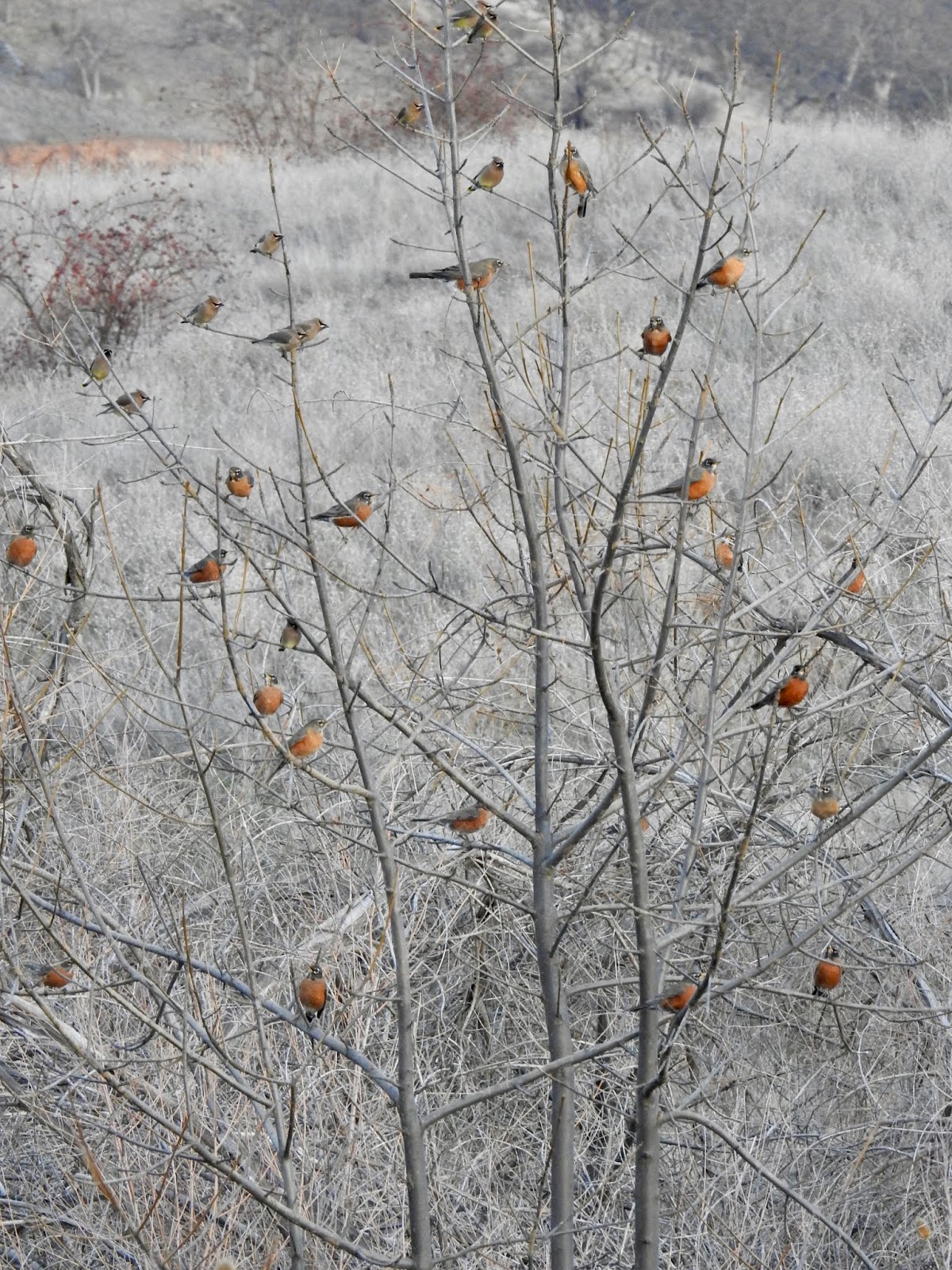
| A tree full of Robins and a few Cedar Waxwings. |
In mid January I found a Swamp Sparrow in nearby Yamhill County. I and another birder have been back a few times trying to refind him, without success. On 1/24 I found a Chukar, most certainly an escapee from some local game bird farm.
 |
| The chukar - a bird found east of the Cascades in dry, rocky, hilly areas. This bird must be an escapee from a local game farm |
 |
| Chukar |
 |
| Nutria, the bane of the Willamette Valley. Having been introduced a few decades ago, they are found all over the place wherever there standing water They are here to stay. Brought originally frto Louisiana from South America, they have spread to many areas in North America. |
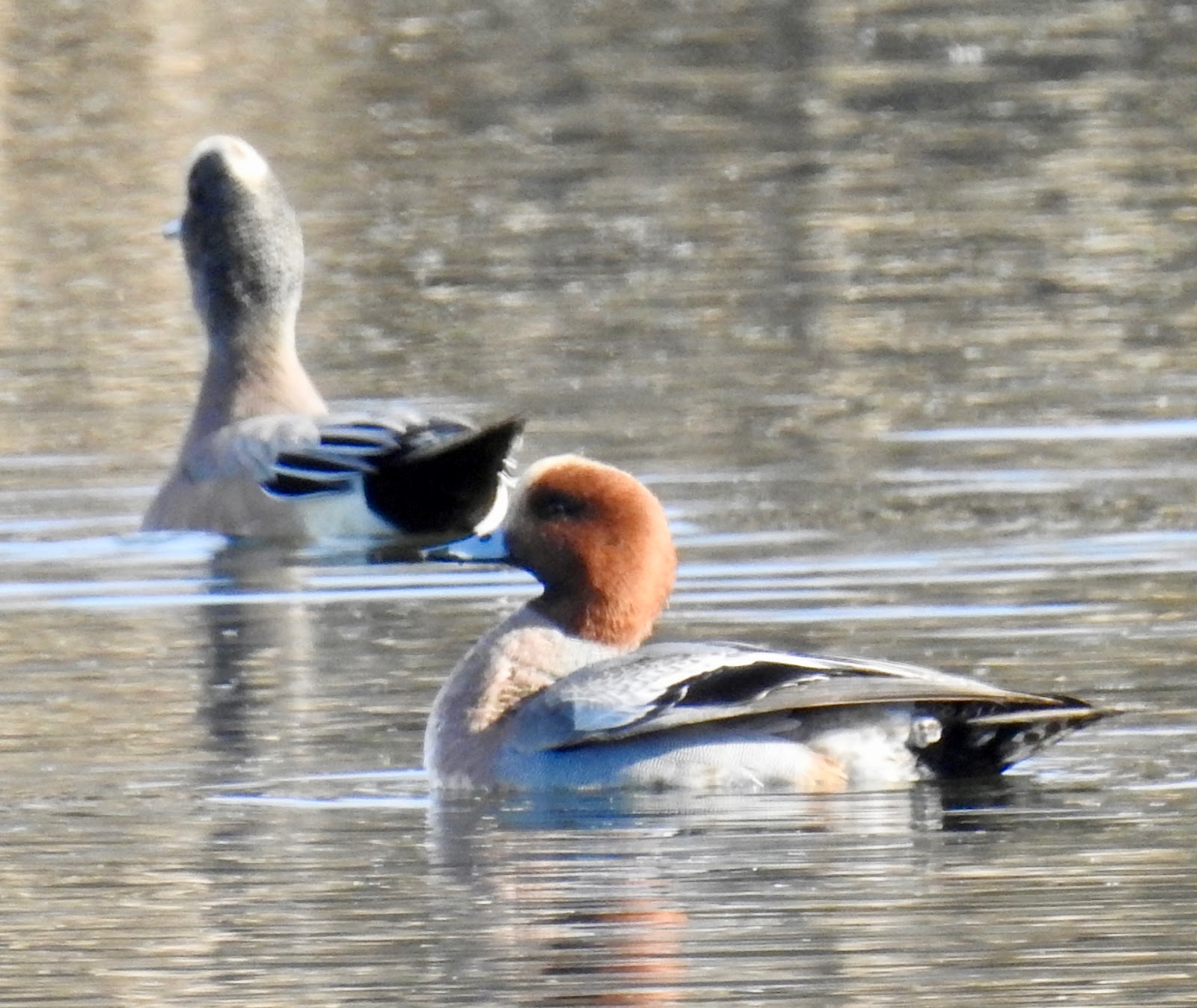
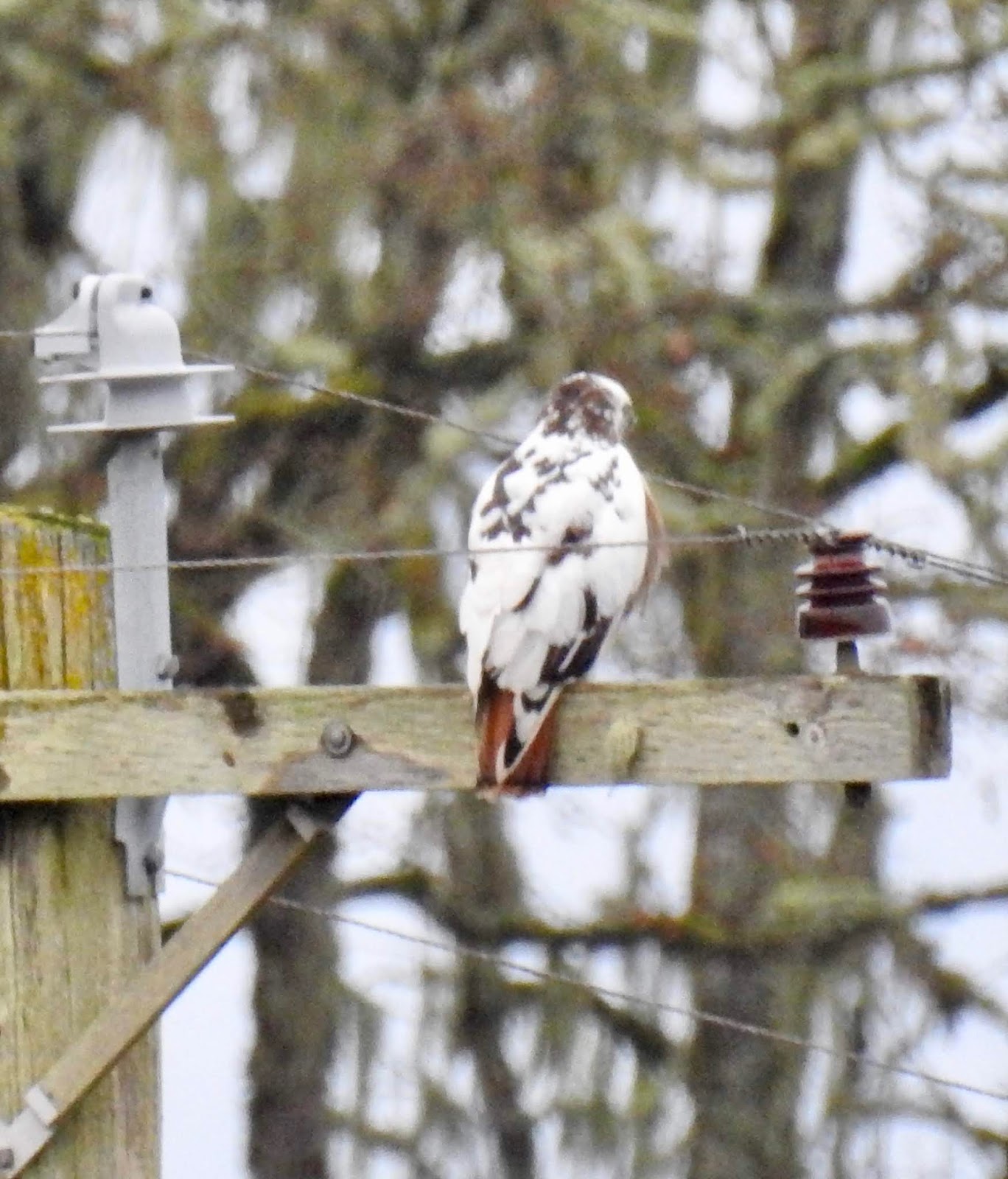
On Friday 1/25 we headed south to Albany and walked around the Talking Water Gardens for our exercise and saw this Eurasian Wigeon. They are outnumbered by the American Wigeons by a few hundred to one, so, while not rare, they are always nice to see. En route home the partially albino/leucitic hawk was out, so I tried to get a better pic.
 |
| Eurasian Wigeon |
 |
| Great Blue Heron |
 |
| Red-tailed Hawk |
 |
| A coyote hunting at BSNWR |
On 1/27 Paul Sullivan and I headed east to Gilliam County to run a raptor route he has done on and off for a number of years, This was my first. The terrain in the county is largely made up of agricultural land and sage brush, with a few small towns mixed in along with a few creeks. It may be the center of wind turbine operations in Oregon as well. I added 11 species to that county list, ending at 117. Of raptors the common ones were Red-tailed Hawks, Rough-legged Hawks, American Kestrels and Northern Harriers. The less common ones were Golden Eagle, Prairie Falcons, Merlin, Cooper's Hawk and Sharp-shinned Hawk.
One draw for me tagging along with Paul was his recent knowledge of a Barred Owl in the county, a first there, and possibly finding a tricolored blackbird, fairly rare in the county as well, and we were successful on both. Here are a few pics from the 2 days jaunt.
 |
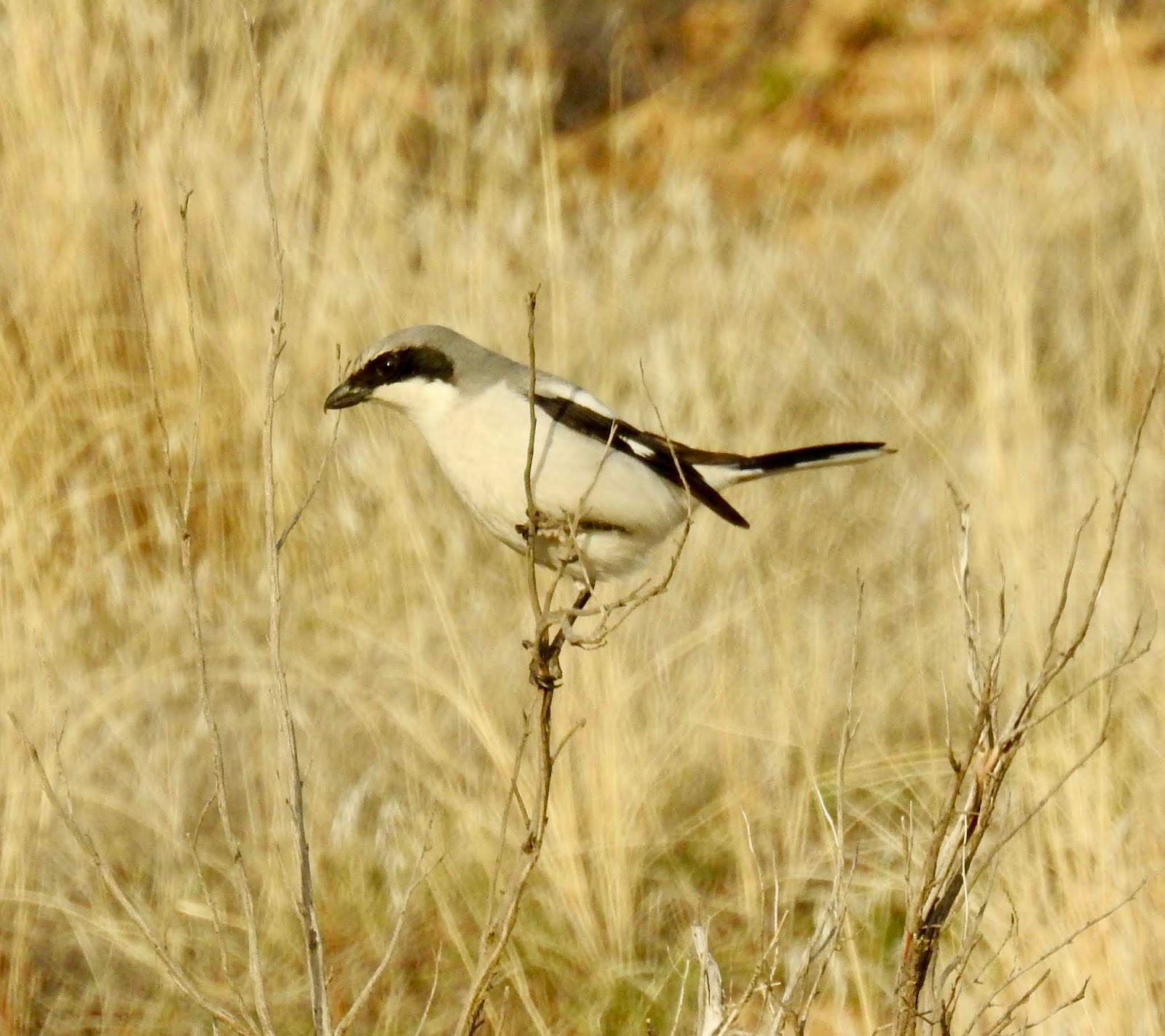
| Loggerhead Shrike |
 |
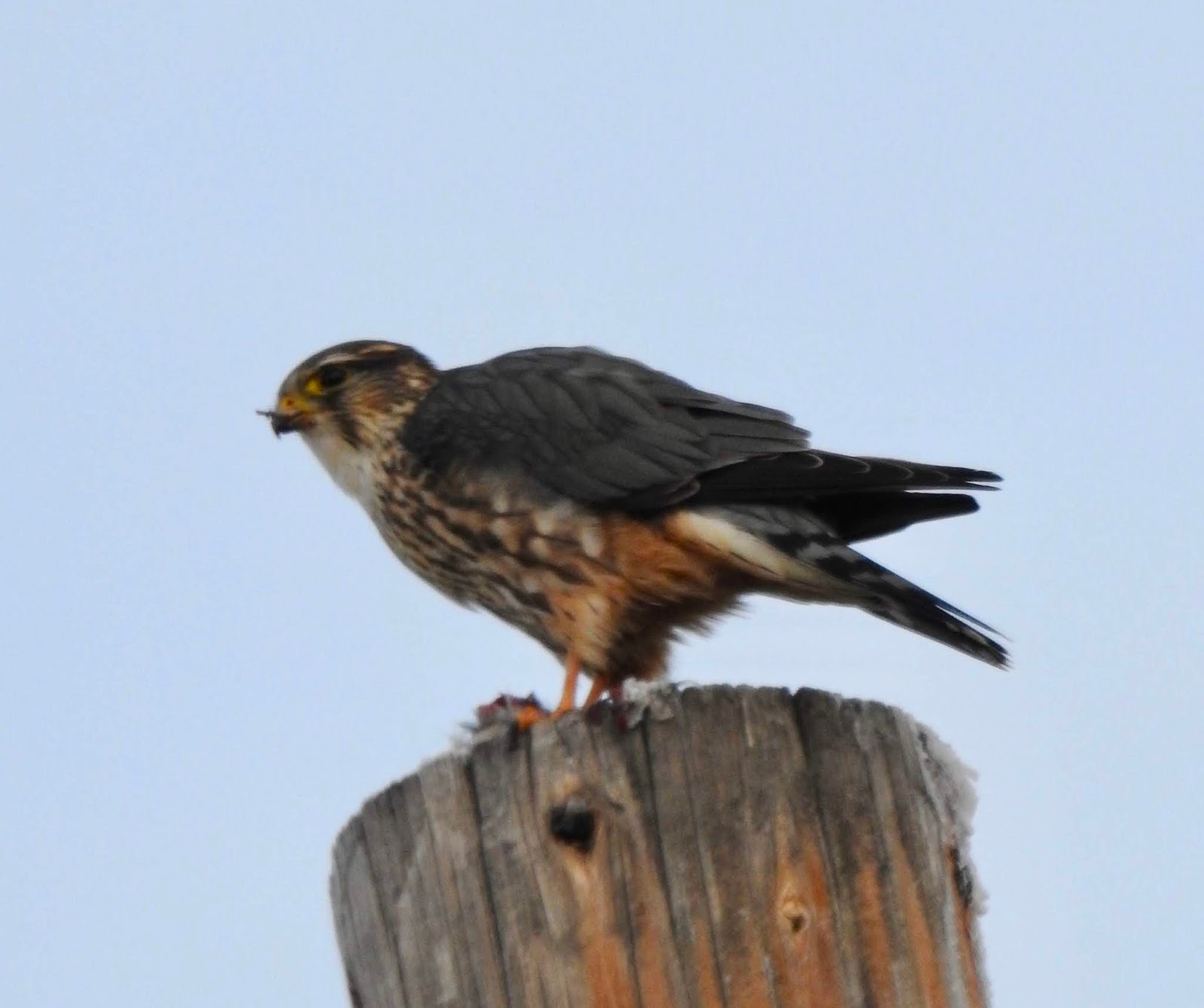
| A merlin eating a small bird |
 |
| Townsend's Solitare |
 |
| Barred Owl, in the barn |
On 1/31 I took a jaunt with another birder over again to Tillamook County on the coast. A couple more rare sparrows showed up and were consistently coming to some seed being scattered for them. We were able to see both of these, a Lark Sparrow and a Clay-colored Sparrow. I was only able to get a decent shot of the Lark Sparrow. Also included is a pic of a Swamp Sparrow, usually a skulker and difficult to photograph, this one was somewhat obliging.
 |
| Lark Sparrow |
 |
| Swamp Sparrow |
Feb 7 found Chuck Philo and I heading from the coastal town of Newport south near Florence. The big draw was a Yellow-bellied Sapsucker, a rare eastern visitant, and big incentive to work on my Lane County list. I did not end up getting good pics of it, but did get a decent pic of a Hermit Thrush. The other pic is of a Magnolia Warbler, which really isn’t that great of a pic either, but represents a rare wintering eastern warbler which I had already seen but finally got a good pic.
 |
| Hermit Thrush |
 |
| Magnolia Warbler |
2/9//19 - Coming home from church I detoured onto Farmer Road where a friend reported 4 Chipping Sparrow recently, rare winter residents, and was able to refind them. Here is one:
 |
| Chipping Sparrow |
There are many interesting birds around the state, so it is a challenge sometimes to figure out if you have the time to take a 2-3 hour drive for this or that. Locally, I saw this Hooded Merganser hanging close to the road, allowing me a decent picture. I distant Golden Eagle was seen later in the day, a tough bird to find locally.
 |
Male Hooded Merganser. A beautiful bird, and I wish
he were just a little closer so more details could be seen. |
3/15/19 - We are finally having some spring days. Today it almost hit 70 degrees and Rosie and I had a nice walk. In this past week there have been some excellent rare birds just SE in Linn County, where I was for 2 days finding Lapland Longspur, Chestnut-collared Longspur, Snow Bunting and this Clay-colored Sparrow. The Chestnut-collared Longspur is the rarest, maybe only a dozen records statewide, so that was the big draw. I could not get a pic of him, and he was not very pretty anyway, but here are some pics I did get this week.
 |
| Snow Bunting. My brother in law said he looks like a stuffed animal |
 |
| Clay-colored Sparrow |
 |
Brown Creeper
|
The following pics are basically experiments with a borrowed camera (which I might buy, and a rented lens. I might buy the same kind of lens. Tis time to upgrade, and I have been thinking of such for a long time, so it may be that from henceforth, the pics added to my blogs will be with better equipment, and should be better quality.
 |
| Male Western Bluebird on my bird feeder. Looks like he let me know what he thinks of it......I think the gleam in his eye is the flash from the camera. |
 |
| A lone cackling goose at the refuge |
 |
| Male Gadwall at the refuge. This is at least 200 feet away, so not too bad. |
 |
Osprey on nest. I think the bird was just resting as it is a little
too early to have laid eggs. Notice the flowers? |
 |
| Red-breasted Sapsucker |
 |
| Immature Bald Eagle. On Sauvie Island, near Portland where this photo was taken, we must have seen about 50 eagles today. |
 |
| Female Mountain Bluebird on Sauvie Island. A first for Columbia County in quite a while |
 |
| Black-capped Chickadee |